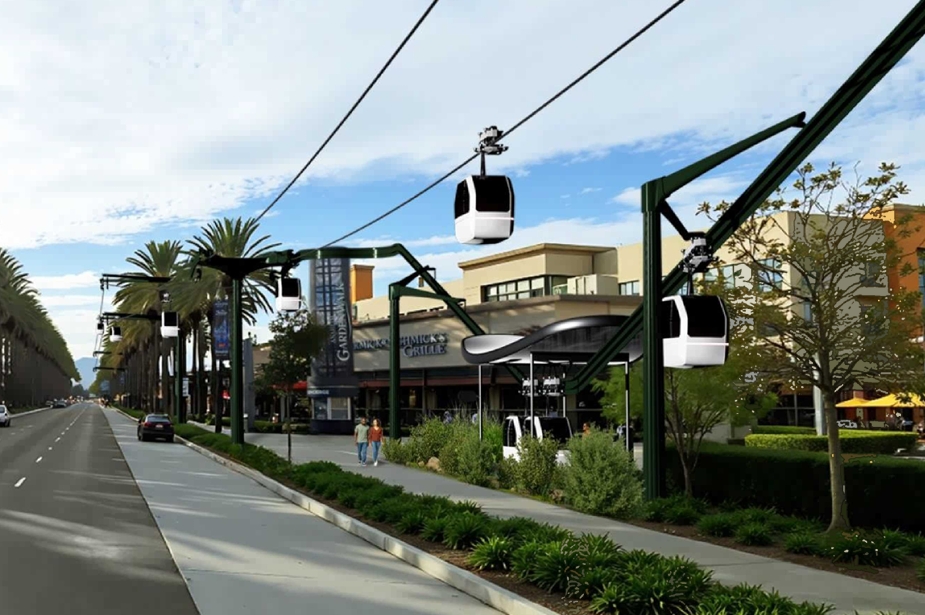
Concept image of what a gondola stop at Anaheim GardenWalk, located on the northside of Katella Avenue, might look like.
By DUANE J. ROBERTS Editor & Publisher
Internal emails, contracts, and PowerPoint presentations obtained by The Anaheim Investigator through the public records act reveal city planners are exploring the option of constructing an aerial gondola system to connect the Platinum Triangle with the Anaheim Resort in preparation for the 2028 Summer Olympics in Los Angeles.
While the final route has yet to be decided, there seems to be interest in an alignment running east-west along Katella Avenue featuring six stops. At Harbor Boulevard, the line would split into two branches, each ending near the eastern entrances of Disneyland, California Adventure theme parks and the Anaheim Convention Center.
The Katella Avenue route for the proposed gondola system.
Emails reviewed by The Investigator show Jeral Poskey, CEO of Swyft Cities, and Clay Griggs, one of the firm’s co-founders, have already discussed their gondola concept with “key stakeholders” such as The Walt Disney Company and OCVibe, a $4-billion mixed-use district being developed on 100-acres of land surrounding the Honda Center.
In a March 5th message Griggssent out to several city planners working with him on this matter, he emphatically boasted that “our meeting earlier with OCVibe went very well,” hinting they were quite supportive of it. “They will be sending over plans for the parking garage; they are currently envisioning our maintenance facility on the top floor.”
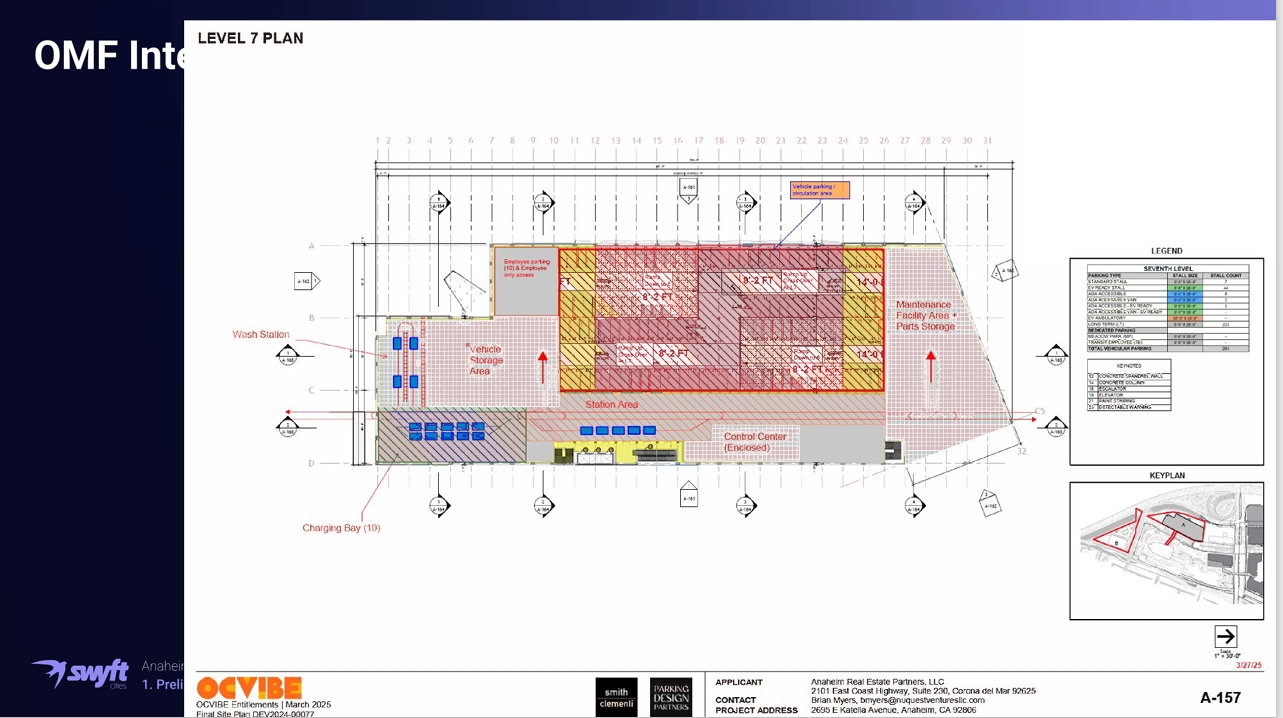
Indeed, a floor plan created by OCVibe and reproduced in a PowerPoint slide demonstrates their commitment to Swyft Cities isn’t just limited to offering space for a “maintenance facility,” but a control center, charging bays, and even a boarding station–all within walking distance of the Anaheim Regional Transportation Intermodal Center.
OCVibe floor plan for a gondola maintenance facility.
Concept image of gondolas next to OCVibe parking garage.
During initial talks with Swyft Cities, city planners were told that towers erected to hold the gondola cables in place could be specially customized to resemble the Los Angeles Angels’ iconic “Big A” logo—an idea which taps into Anaheim’s distinct character as being the only city in Orange County that hosts a major league baseball team.
Two design renderings the firm created not only contrast the scale and form of an imagined “Angels” tower with a “standard single” tower but also provide a birds-eye glimpse of how it might actually appear in real life facing west on Katella Avenue toward the Anaheim Convention Center and California Adventure theme park.
However, building a gondola system along Katella Avenue might be problematic. As Poskey himself acknowledged in an email, there are “palm trees”–literally hundreds of them. Many would have to be removed to make way for the towers, and it is not inconceivable that could generate opposition from both residents and hoteliers alike.
“Angels” tower vs. “Standard Single” tower.
Concept image for a gondola system using “Angels” towers.
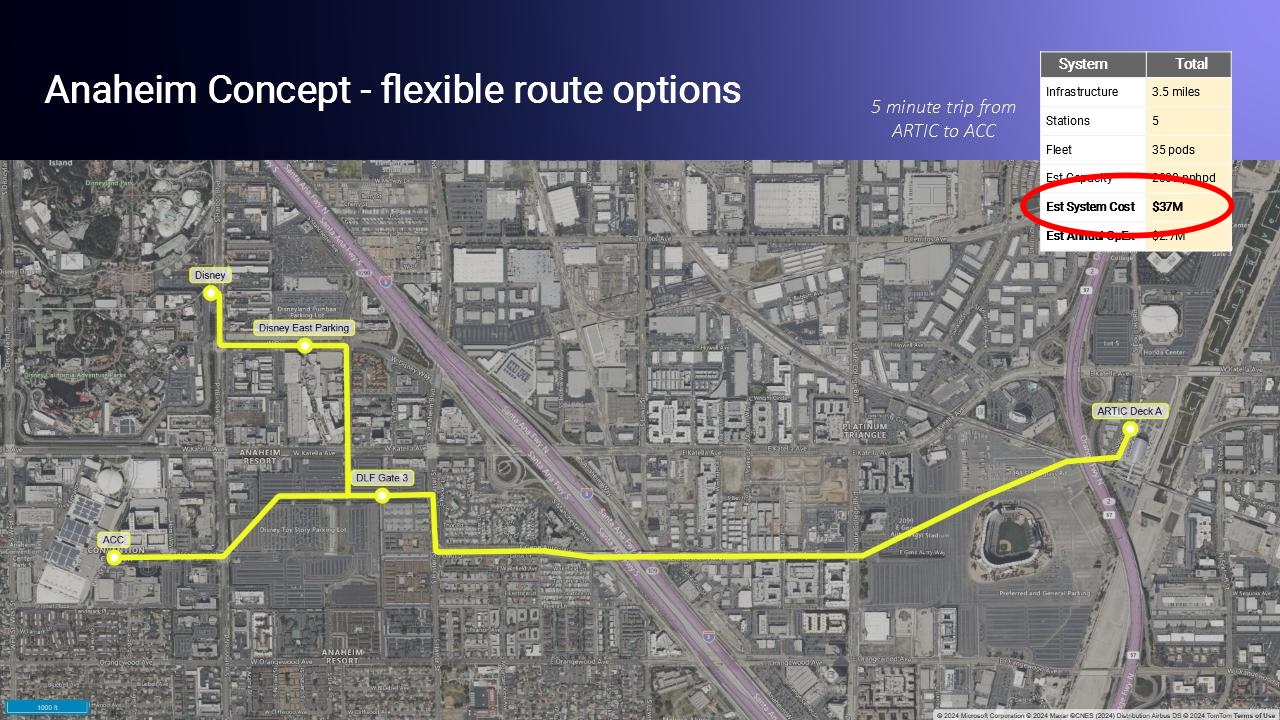
Last December, Swyft Citiesshared a PowerPoint presentation indicating that their gondola system—comprising of a fleet of around 35 “pods”—could be implemented at an estimated cost of roughly $33 to $37 million. This equated to just under $11 million per mile, subject to variation based on final design and alignment considerations.
Estimated cost for a 3.5-mile route last December: $37 million.
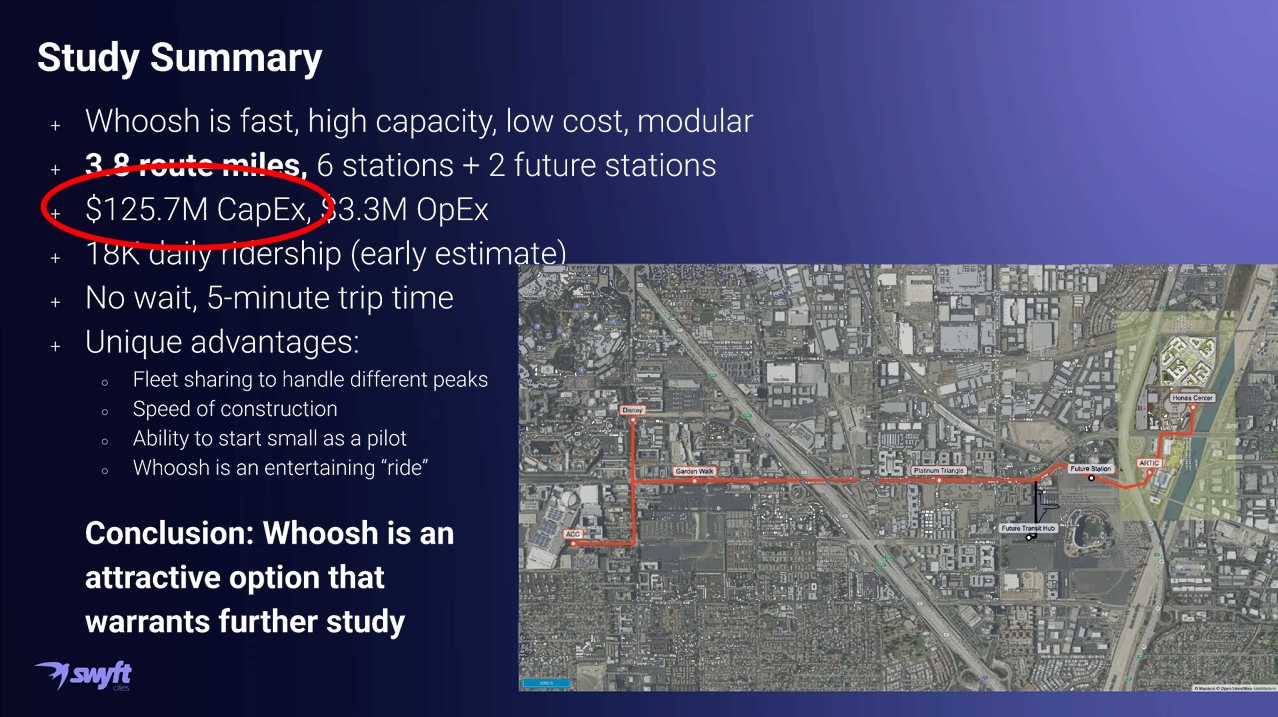
Estimated cost for a 3.8-mile route in July: $125.7 million.
As of today, no source of funds has been identified to pay for this system. However, one slide included in the July PowerPoint presentation says that financing could come from public-private partnerships, grants, and the California Infrastructure & Economic Development Bank, a public entity owned and operated by the state.
Emails reveal city planners here reached out to their Irvine counterparts to learn more about it. “I wanted to check in to see if you have cost estimates or any other useful information to share in your due diligence on Swyft Cities,” wrote Rudy Emami, public works director, in a March 11th message to Sean Crumby, who held a similar job in that town.
Email inquiry about the gondola project in Irvine.
While “key stakeholders” like OCVibe have quietly expressed enthusiasm for the gondola system, its implementation is not a foregone conclusion. Because Swyft Cities has never delivered a fully operational system, there are concerns about its ability to fulfill its promises–putting taxpayer money at risk of significant cost overruns and system failure.
Mike Lyster, the city’s chief communications officer, told The Investigator that gondolas aren’t the only option being explored to connect the Platinum Triangle and Anaheim Resort: “We continue to look at transportation technology from a half-dozen or more different providers. It would be incorrect to suggest we’re focused on a single one.”
“In the months ahead, we could issue a potential request for information from many different types of transit tech companies out there, including gondola, trackless, autonomous, trams and others,” Lyster added. “We may need a consultant to help with this process … But nothing has been decided, and nothing is scheduled at this point.”
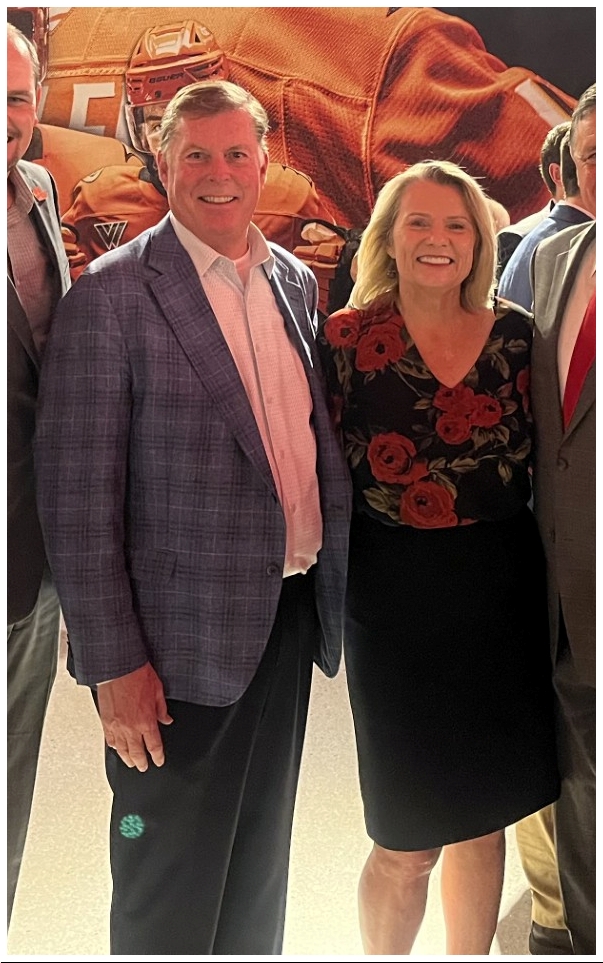
Curt Pringle. president of Curt Pringle & Associates, with Councilwoman Natalie Meeks at OCV!be Unveiled on September 25, 2024.
By DUANE J. ROBERTS Editor & Publisher
The Anaheim Investigator has evidence which suggests that Councilwoman Natalie Meeks might have deliberately withheld information from her public calendar to conceal the fact she met with a registered lobbyist hired by a company that seeks future contracts with the city potentially worth millions of dollars.
The lobbyist in question, Curt Pringle, president of Curt Pringle & Associates, not only has known Meeks since 2007 when she served under him as director of public works while he was mayor, but campaign finance paperwork filed with the city clerk shows both he and his wife contributed several thousand dollars to her city council campaign in 2022.
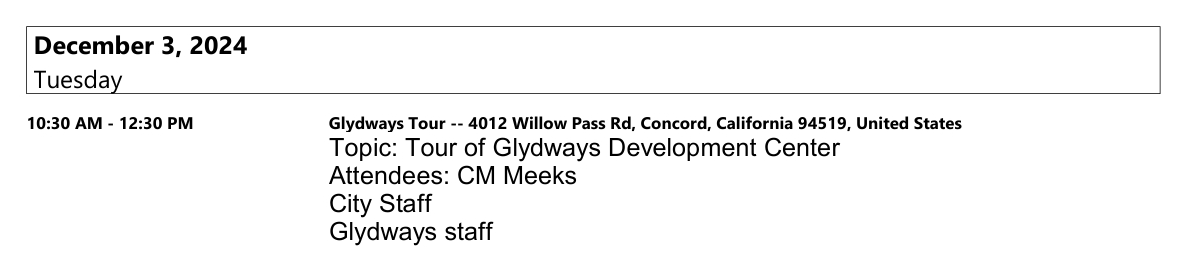
The omission was discovered by a confidential source who tipped off The Investigatora few days after noticing glaring discrepancies between two December 2024 entries in public calendars posted online by Meeks and Deputy City Manager Ted White, who was also with the councilwoman when she met Pringle.
Meeks’ December 3rd entry about the Glydways meeting.
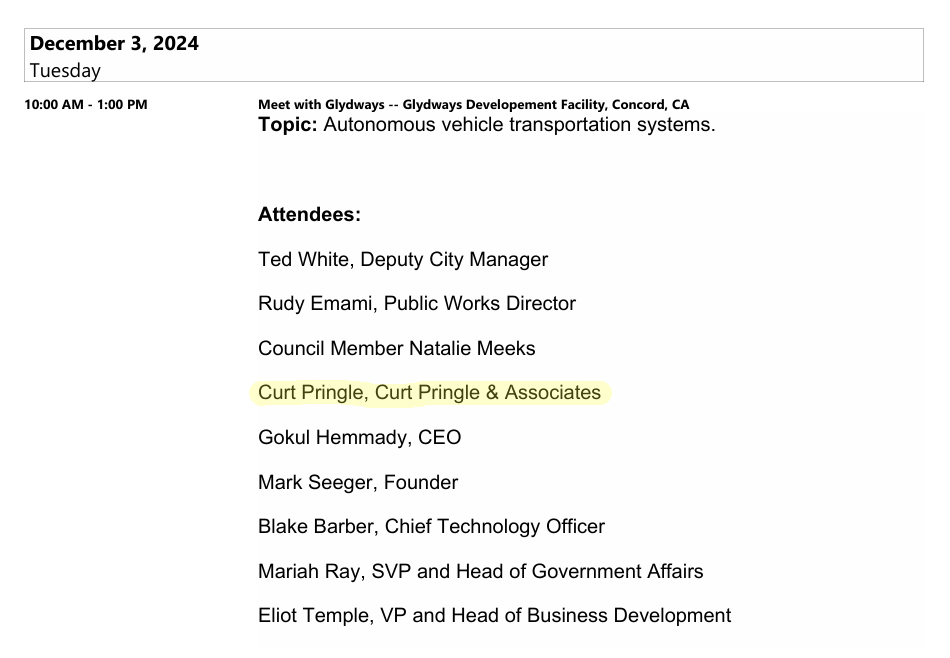
White’s entry, however, was more detailed. Not only did he state the topic of the meeting but recorded the names and titles of everybody present. According to him there were nine people, including himself, Meeks, and Rudy Emami, the current director of public works. And who was the lobbyist? “Curt Pringle, Curt Pringle & Associates,” he typed.
White’s December 3rd entry about the Glydways meeting.
This is not the first time Meeks has failed to disclose her interactions with Pringle. Several photographs The Investigator obtained of OCV!be Unveiled, a ceremony which took place on September 25, 2024, not only reveal the councilwoman was present, but she can be seen mingling with both Pringle and Matthew Hicks, another registered lobbyist.
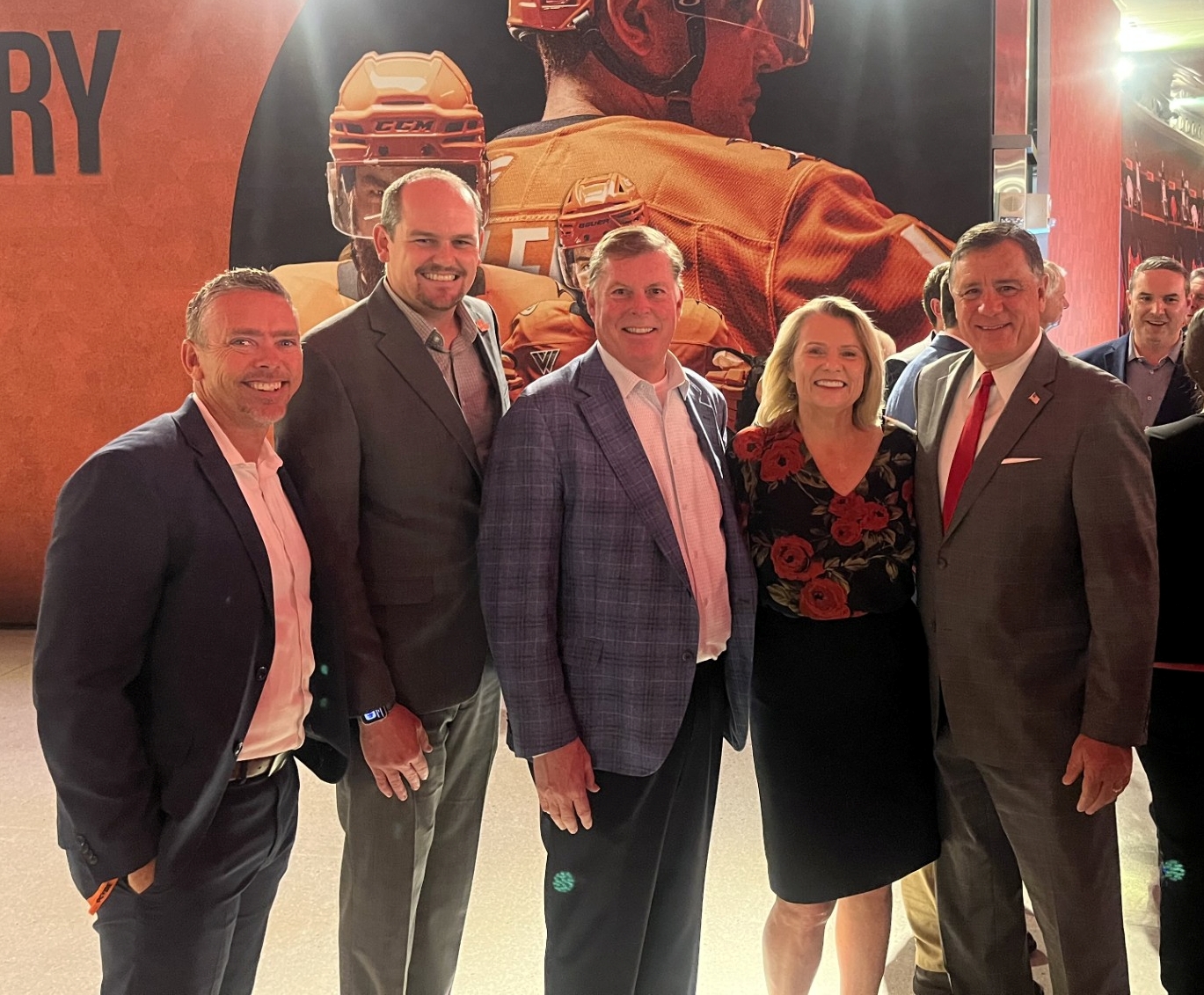
One image shows Meeks standing next to Don Wagner, an Orange County supervisor who serves the third district. Pringle can be seen on her right, along with Hicks and Paul Simonds, who was then senior vice president of Curt Pringle & Associates. Directly behind them is a photo collage composed of Anaheim Ducks hockey players.
The Investigator has no evidence that city business was discussed during this encounter. And a thorough review of Meeks public calendar for the month of September shows that she didn’t even bother to report that she attended this ceremony. However, to be completely fair, neither did Mayor Ashleigh Aitken, who was there as well.
Simonds, Hicks, Pringle, Meeks, and Wagner.
Meeks close relationship with Pringle spans across two decades. During her tenure as public works director, which began in 2007, she championed many of the same projects he backed as mayor, including building ARTIC near the Angel Stadium. She, like him, also favored a streetcar system connecting the Anaheim Resort with the Platinum Triangle.
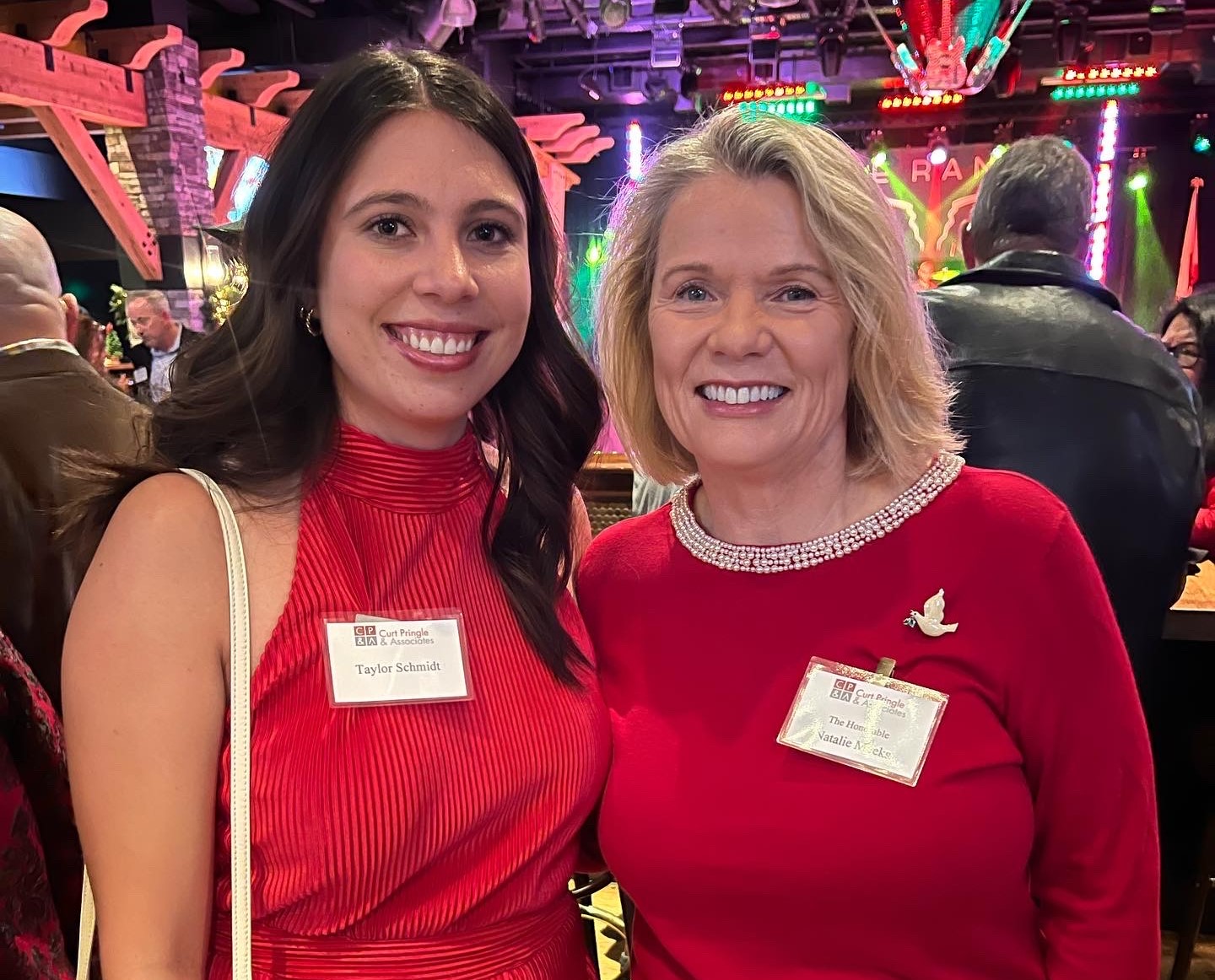
Her loyalty to Pringle was handsomely rewarded in 2022 when he not only endorsed her for city council but, along with his wife Alexis, pumped $4,400 into her campaign. About a month after Meeks emerged victorious in that race, photos The Investigator has in its possession show her hanging out at Curt Pringle & Associates annual holiday bash.
However, the COVID-19 pandemic, plus revelations Sidhu was under investigation by the FBI for corruption, put discussions about these matters on hold. The ball was later picked up by the Anaheim Transportation Network, the quasi-public company that operates a fleet of electric buses which shuttle tourists and workers around the Anaheim Resort.
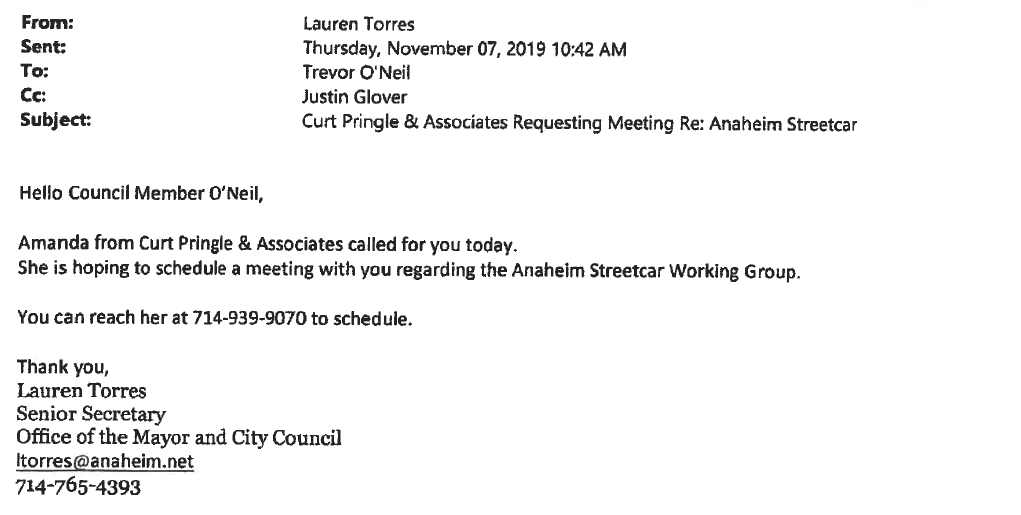
An email obtained by The Investigator in 2020.
Glydways, the firm that hired Pringle as a lobbyist, is a high-tech company headquartered in San Francisco. Though not a streetcar manufacturer, it is developing small driverless vehicles, one option city officials are now considering in preparation for the 2028 Summer Olympics in Los Angeles, which is expected to draw millions of visitors.
On its website, Glydways claims cities will spend less on infrastructure if they adopt their system. Maybe so. However, it still might be a tough sell if it eventually comes before the city council. Such transit projects require millions of dollars in federal grants. And with Donald Trump in power, its not a sure thing Anaheim will get them.
From Glydways website.
For the record, The Investigator reached out to Meeks for comment. For example, we asked her everything from why she didn’t include Pringle’s name on her December 3rd entry to inquiring if her office initiated the Glydways meeting. We questioned her about what dealings she had with Pringle and Hicks at the OCV!be Unveiled ceremony.
The councilwoman issued the following statement:
The OCVibe event was a celebration for the initial phase of construction. No business was discussed and, under the guidelines in place at the time, it was not a meeting listed on my public calendar.
The December 3 meetings in Northern California were coordinated through city staff at the request of those transportation vendors. They were both educational meetings to learn about the transportation technologies each company is pursuing.
Several questions were emailed to Mike Lyster, chief communications officer for the city, which were also copied to other city officials, including the city ethics officer. Because we were aware of Meeks close ties to Pringle, our primary concern was whether or not she, or her senior policy aide, set up the meeting on his behalf.
In response, Lyster wrote:
The meeting was not initiated by Mayor Pro Tem Meeks or her office. Meeks did not bring the company to our attention.
Anaheim Public Works had been talking with Glydways since early 2023. Extending out of that conversation was an invitation to visit the company’s test track.
Other Council members were also invited for the visit. As an engineer by training, Meeks opted to join the city delegation, which also included city staff.
Glydways is one of several types of transportation technology we look at on an ongoing basis. Others include Swyft Cities,Waymo and Tesla’s autonomous vehicles.
We look at transportation technologies, including Glydways, with an eye toward moving people between the Anaheim Resort and the Platinum Triangle, not necessarily for the 2028 Olympics but with potential benefits for the event.
All of this remains in the exploratory stage with no technology or course of action set at this point.
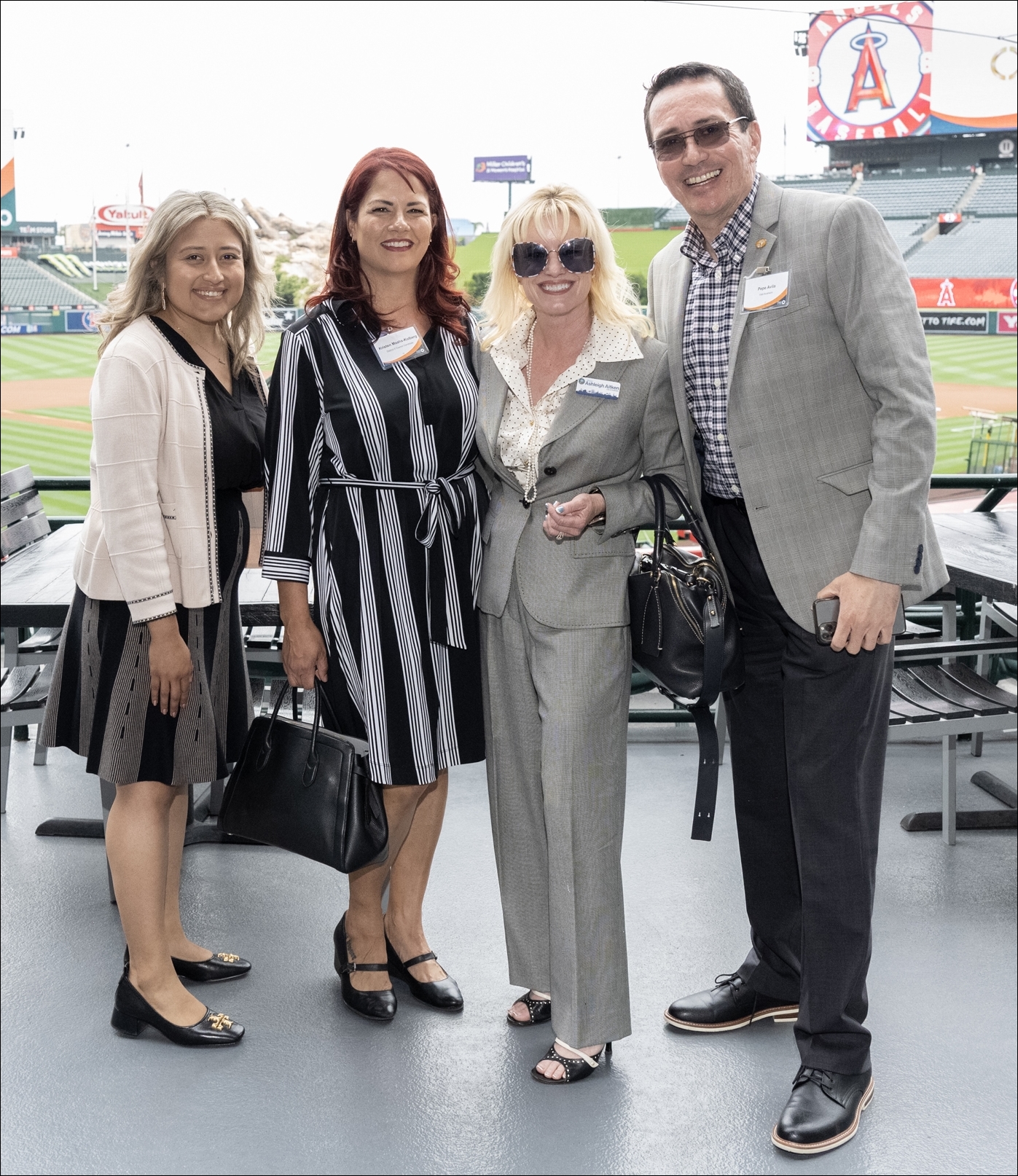
Berenice Ballinas, Kristen Maahs-Kolberg, Mayor Ashleigh Aitken, and Pepe Avila at Angel Stadium on June 7, 2024.
By DUANE J. ROBERTS Editor & Publisher
More than 200 photographs currently in the possession of The Anaheim Investigatorshow that although the Anaheim Chamber of Commerce luncheon at Angel Stadium on June 7th attracted far less council members than it did back in 2023, there were more candidates. Furthermore, a number of new faces were present this year, including Paul Kott, a local realtor, and Josh Newman, a state senator that represents the 29th district.
Several others show Aitken mingling with Ross McCune, owner and president of Calsteal Builders Inc., and William O’Connell III, director of operations for Stovall’s Hotels of Anaheim. In another photo, the mayor is seated at table in between Jerry Jordan, the new president/CEO of the Anaheim Chamber, and Alicia Valadez-Gonzalez, chairwoman of their board of directors. She is also a community relations manager for Northgate Markets.
Aitken and O’Connell III.
Councilman Stephen Faessal can be seen eating lunch with Dennis Kuhl, chairman of Angels Baseball, and State Senator Newman, who kept fidgeting with his smartphone. Seated right next to him was James Vanderpool, the city manager. Other persons in attendance included the Mayor’s Chief of Staff Berenice Ballinas, Mayor Pro-Tem Norma Campos-Kurtz, Fire Chief Pat Russell, and Third District Supervisor Don Wagner.
Ryan Bailus, a candidate running for city council in district 1, also made his presence known. Unlike Maahs-Kolberg and Campos-Kurtz, both of whom will be facing voters for the very first time in November, this is his second try. In 2020, Bailus ran a spirited campaign against Councilwoman Denise Barnes, an incumbent, and Jose Diaz, coming in third with 19.8% of the vote. This year his only opponent is Ojaala Ahmed.
Bailus and Wagner.
The luncheon, an annual event that is organized by the Anaheim Chamber, typically brings in a youth sports league from the local community to meet and interact with persons who played for Angels Baseball, both past and present. However, the only featured guests this time around were Perry Minasian, the team’s general manager, and Trent Rush, a reporter and host forAM 830 KLAA, a radio station owned by the club.
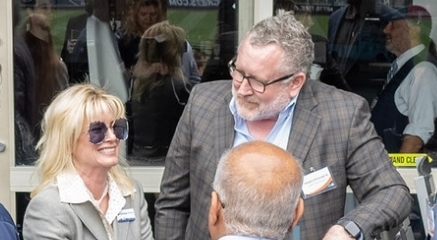
Ashleigh Aitken (c) and Molly Jolly (r) at an event celebrating the opening of a Girl Scouts facility in Newport Beach in 2017.
By DUANE J. ROBERTS Editor & Publisher
Evidence uncovered by The Anaheim Investigator strongly suggests Mayor Ashleigh Aitken has been a longtime friend of Molly Jolly, senior vice president of Finance/Administration for Angels Baseball, a relationship which appears to have been formed through their past involvement in the Girl Scouts of Orange County, a well-known non-profit organization that both women have championed.
Not only does The Investigator have photographs of Aitken and Jolly mingling at a gathering of wealthy donors celebrating the opening of a Girl Scouts facility in Newport Beach, but has proof that they served on at least one committee together. Furthermore, Form 990s filed with the Internal Revenue Service show Jolly sat on the board of directors of that non-profit for at least eight years.
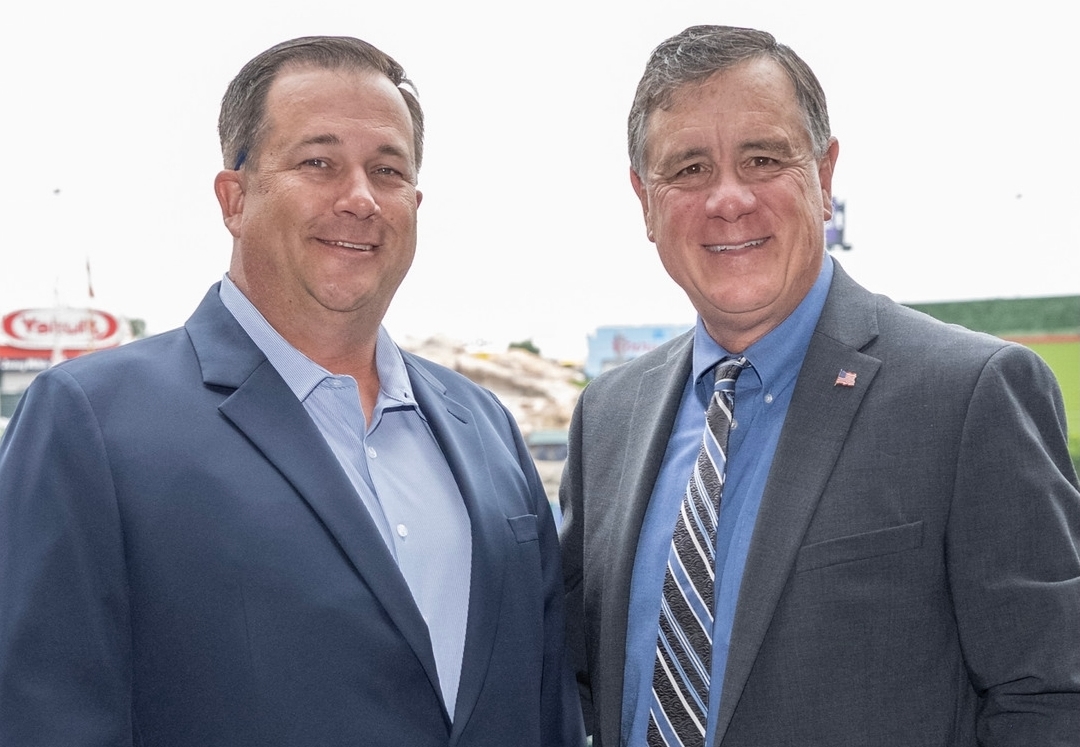
Jolly, Cunningham, and Aitken at the June 6th luncheon.
Though it is unclear as to when the friendship between Aitken and Jolly first began, newspaper articles, annual reports, photos, and other materials reviewed by The Investigator hint both women started crossing each other’s paths roughly a decade ago when the future mayor began participating in “Celebrate Leadership” fundraisers for the Girl Scouts of Orange County, usually held at the Fashion Island Hotel in Newport Beach.
In 2013, Kelley Bennett, a high society columnist for the Mission Viejo News, reported that Aitken herself was one of six honored at that year’s fundraiser. “We are proud to recognize these exceptional women,” she quoted Nancy Nygren as saying, who was then-CEO of the non-profit. “They are each leaders in their respective fields and truly serve as role models for tomorrow’s female leaders.”
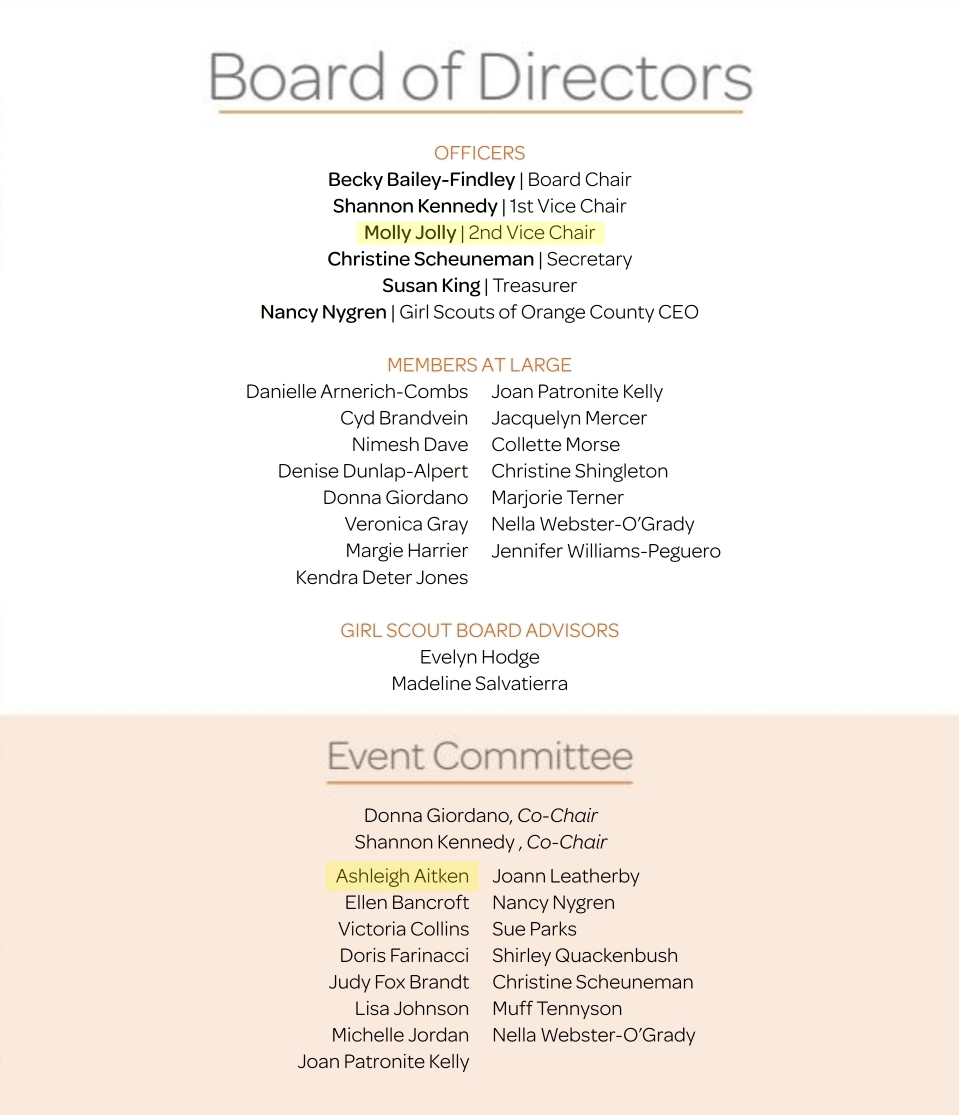
Within a year, Aitken and Jolly took on greater roles within the organization. For example, a Form 990 shows that while the latter was elected to the board of directors in 2014, the former eventually joined a committee tasked with organizing their annual “Celebrate Leadership” fundraisers. By 2016, Aitken was co-chair, and in one instance served alongside Jolly and others to plan the one for 2017.
Names highlighted from a Girl Scouts calendar printed in 2015.
Jolly isn’t the only Angels Baseball executive Aitken has had dealings with before becoming mayor. A Form 990 filed in 2020 by Alzheimer’s Orange County shows she sat on the board of that non-profit the same time Dennis Kuhl, chair of that sports team, was a director. The Investigator also has evidence Kuhl has ties to another member of her family, something that will be disclosed in a future story.
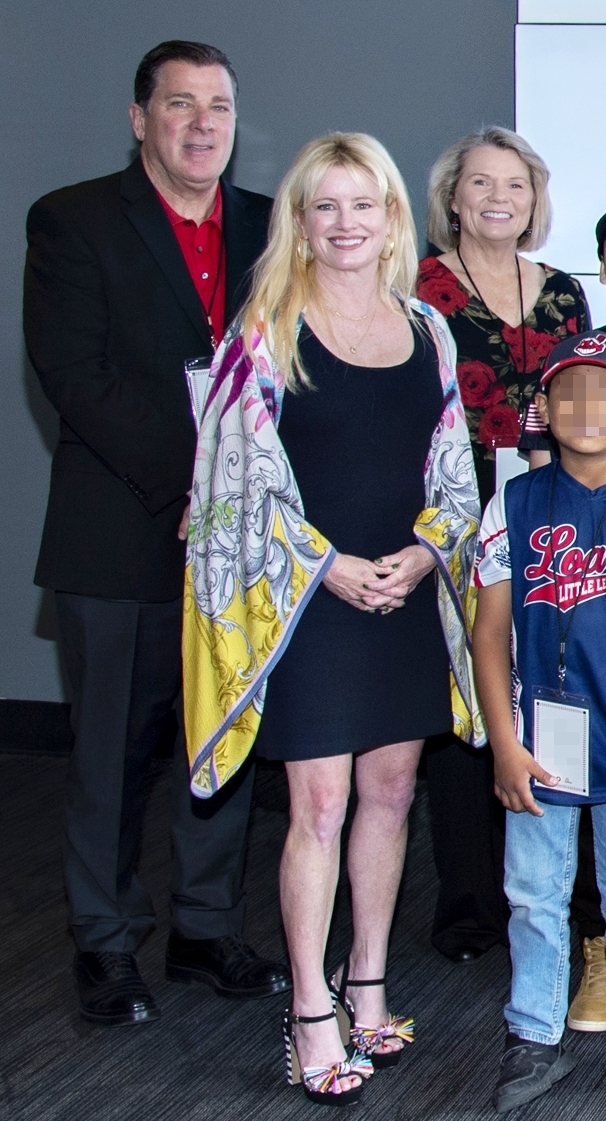
Jolly in 2019.
For matter of record, The Investigator reached out to Aitken via email at least three times posing questions about the extent of her relationship with Jolly and whether ties to the executive would affect her ability to be fair and impartial in any future negotiations the city might have with the Angels Baseball team. But so far, the mayor has failed to respond to our requests for comment.
[Update: An earlier version of this post stated Molly Jolly became chair of the board of directors of the Girl Scouts of Orange County in 2018. That is incorrect. She was elected in 2019.]
Matt Cunningham, James Vanderpool, Molly Jolly, and Laura Cunningham having lunch with Mayor Ashleigh Aitken.
By DUANE J. ROBERTS Editor & Publisher
The Anaheim Investigator has reviewed more than 200 photographs that were taken of a luncheon held at Angel Stadium on June 6th which not only clearly show Mayor Ashleigh Aitkensharing a table with Laura Cunningham, president and CEO of the Anaheim Chamber of Commerce, but Molly Jolly, senior vice president of Finance/Administration for Angels Baseball.
In one photo, the mayor can be seen talking to Matthew Hicks, vice president of Public Affairs for ocV!BE, a $4 billion mixed-use development surrounding the Honda Center that is controlled by Henry Samueli, a Newport Beach billionaire. In another, John Carpino, president of Angels Baseball and right-hand man for team owner Arte Moreno, is standing directly behind her.
Mayor Aitken was not alone at this event. Photos show Councilman Stephen Faessel sat at the ocV!BE table between Hicks and George Urch, their lobbyist. Councilwomen Natalie Meeks and Norma Campos-Kurtz were huddled together off to the side, not far from Mike Lyster, chief communications officer for the City of Anaheim. Fire ChiefPat Russell was also present.
Mayor Pro Tem Natalie Rubalcava and Councilman Jose Diaz were seated at the same table as Aitken was. So was City Manager James Vanderpool, who was stuck in the middle of Jolly and Matt Cunningham, Laura’s husband. Also joining them was Alicia Valadez-Gonzalez of Northgate Markets. One photo shows Berenice Ballinas, Aitken’s Chief of Staff, taking selfies with her.
The Anaheim Chamber of Commerce table.
The luncheon, an annual event that is organized by the Anaheim Chamber, typically brings in a little league baseball team from the local community to meet and interact with persons who played for Angels Baseball, both past and present. Some of the featured guests on June 6th included Patrick Sandoval, Chuck Finley, and Clyde Wright, three generations of Angels pitchers.
Neither Mayor Aitken or any of the five council members who attended this luncheon responded to questions The Investigator emailed them asking about who paid for their tickets and what actions they took to avoid violating the Brown Act, the state law which regulates the conduct of elected officials at meetings. Instead, they directed our questions to Lyster.
“The Brown Act,”he told us via email, “allows a majority of or all Council members to attend public events without discussing city business among themselves. Our Council members are made aware of and follow this practice.” Though Lyster is technically correct, there is one slight problem: tickets to this luncheon cost a whopping $200 per person and were “limited.”
It could be conceivably argued that despite the fact this event was “open” to the public, the steep price of admission created a barrier to access based on wealth and social class: only people with money could afford to attend. The Brown Actmakes it illegal for public meetings to be held in facilities which require payment to enter, but that provision doesn’t seem to apply here.
With respect to the tickets that the mayor, city council, and city staff received from the Anaheim Chamber, Lyster said as follows:
Mayor Aitken, Mayor Pro Tem Rubalcava and Council Members Faessel, Diaz, Campos Kurtz and Meeks attended and were provided tickets.
For Aitken, Faessel and Kurtz, their tickets fall under ceremonial job duties as Aitken addressed attendees, Faessel did the invocation and Kurtz led the pledge of allegiance.
For Rubalcava, Meeks, Diaz and City Manager Jim Vanderpool, it will fall to them to list their tickets as part of a form 700 due in spring 2024.
In a follow up email, he confirmed the city didn’t pay for the tickets and that the Anaheim Chamber gave them away for free.
Carpino, Aitken and Meeks.
Because this is a breaking news story, The Investigator is still in the process of gathering information about this luncheon. Last week, we filed multiple public records act requests with the city to see if there are any emails and other documents which might shed more light on this matter. If we find anything else significant to report on, a follow up article will be written.
For matter of record, The Investigator does not possess the legal expertise to determine if the mayor and city council violated the Brown Act. And even if Lyster is fundamentally correct, none of this changes the fact they were having private conversations with representatives from the Anaheim Chamber, Angels Baseball, and other business interests out of public view.
Interestingly enough, there also seems have been a conscious decision by elected officials to keep this luncheon a secret. With the exception of a notation Aitken posted on her June calendar, nobody has talked about it. If it wasn’t for The Investigator’s dogged determination to expose what politicians do behind closed doors, the public would have never known it occurred.
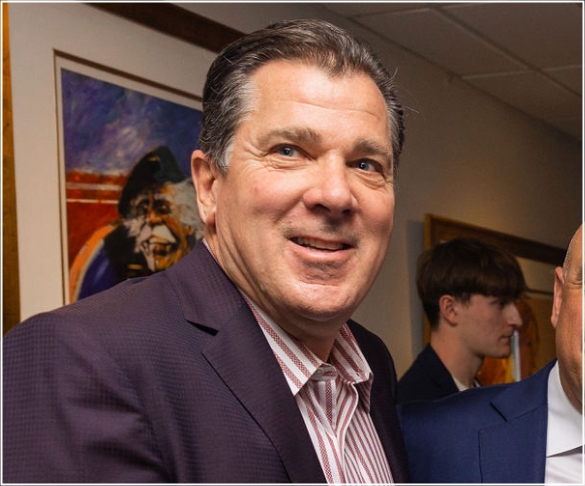
John Carpino, president of Angels Baseball team, at a private event held in Phoenix, Arizona in February 2023.
By DUANE ROBERTS Editor & Publisher
In a recent article published in the Voice of OC entitled, “Who’s on the Hook for Angel Stadium Repairs?,” Hosam Elatar posed several questions to Mayor Ashleigh Aitkenabout issues related to Angel Stadium, including its pending assessment by a private consultant hired by the City of Anaheim. One thing she made perfectly clear: “The Angels have not reached out to me, nor has the city reached out to the Angels.”
However, The Anaheim Investigator has uncovered evidence that Aitken not only secretly met with John Carpino, president of the Angels Baseball team, at a coffee shop in late February, but that the meeting she had with him might have dealt with the Angel Stadium assessment. Why? It was scheduled only thirty minutes before city officials toured the facility with a group of consultants interested in bidding for the job.
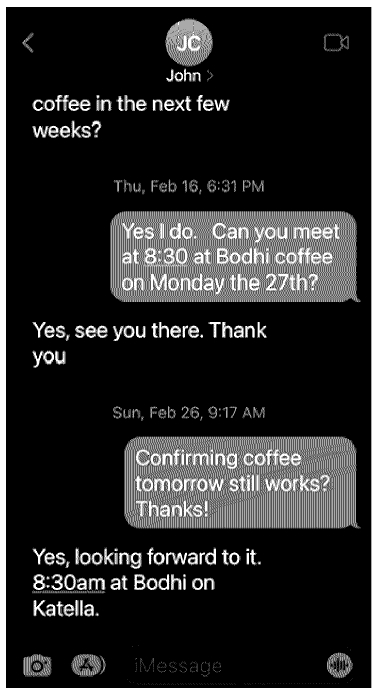
Phone text messages The Investigator obtained under the public records act show Carpino initiated contact with Aitken on Thursday, February 16th. “Do you have time for coffee in the next few weeks?” he asked. “Yes, I do. Can you meet me at 8:30 at Bodhi coffee on Monday the 27th?,” the mayor responded. On February 26th, Aitken texted him again to confirm the meeting was still on. “Yes, looking forward to it,” he said.
Aitken confirming meeting with Carpino.
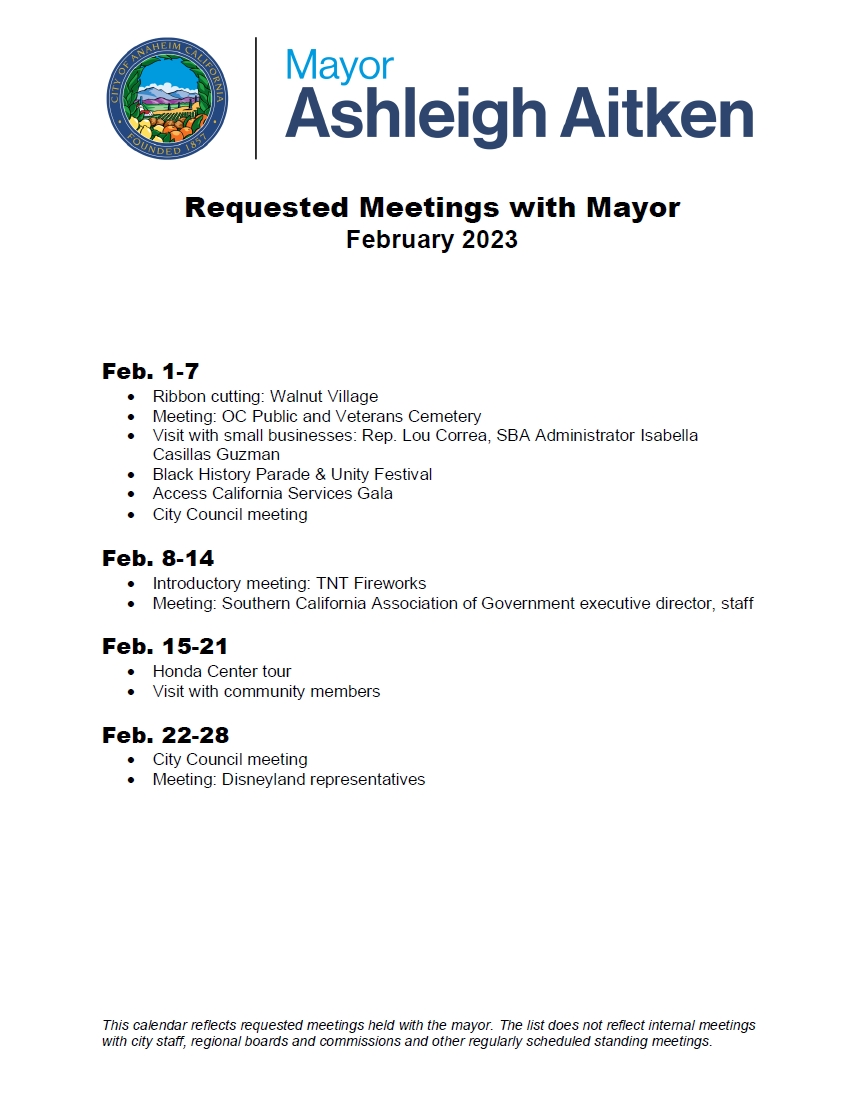
When The Investigator carefully reviewed the February calendar that Mayor Aitken made available to the public which supposedly lists all of the meetings “requested” of her that month, absolutely nothing is mentioned about her having coffee with Carpino on the 27th. During the last week, she stated only two things occurred: a city council meeting and a meeting with “Disneyland representatives.”
No mention of Carpino meeting in the mayor’s calendar.
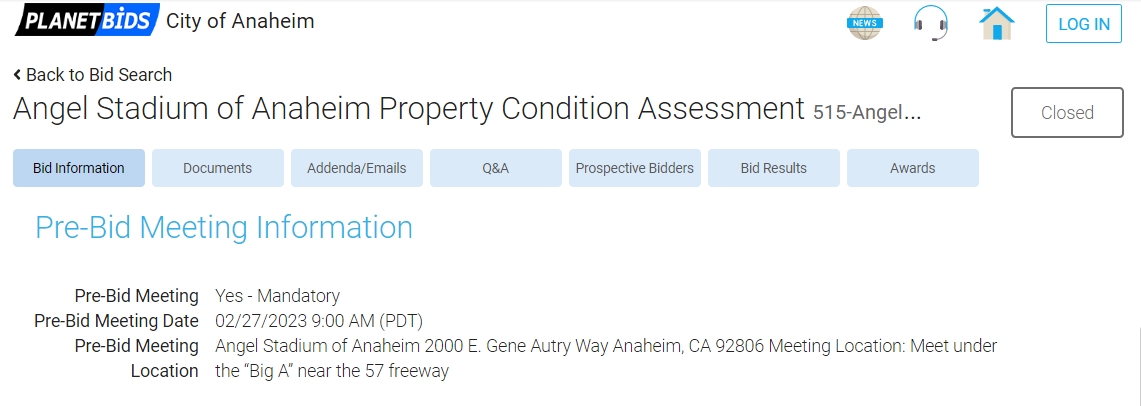
It isn’t a coincidence the secret meeting that Aitken had with Carpino at the Bodhi Leaf CoffeeTraders shop in Orange was scheduled at 8:30 a.m. on February 27th. Approximately thirty minutes later, a group of consultants invited by the City of Anaheim gathered under the “Big A” sign to do a tour of Angel Stadiumto bid on “a property condition assessment” of that facility. A sign-in sheet recorded that 25 persons attended.
Partial screenshot of website listing Angel Stadium tour.
Furthermore, several letters show that just days before their meeting, both Carpino and ArentFox Schiff LLP, a prestigious law firm retained by the sports team, demanded that the city cancel the tour of Angel Stadium, asserting it was a violation of the lease agreement–a claim vigorously rejected by City Manager James Vanderpool and City Attorney Robert Fabela. Carpino made sure to copy his letter to Aitken.
So far, the mayor hasn’t responded to questions The Investigator sent regarding the secret meeting she had with Carpino in late February. But perhaps it should be noted these types of behind-the-scenes political maneuvers with executives of the Angels Baseball team are part of the reason why former Mayor Harry Sidhu got into trouble with the Federal Bureau of Investigation and was forced to resign his seat.
Below are letters exchanged in February between representatives of the Angels Baseball team and the City of Anaheim regarding the tour of Angel Stadium.
Ashleigh Aitken speaking at the headquarters of United Food and Commercial Workers Local 324 in November 2018.
By DUANE ROBERTS Editor & Publisher
In early January, Ashleigh Aitken, the newly-elected mayor of Anaheim, did what many public officials before her had done. She took full advantage of her unfettered access to the city’s vast pool of free tickets to luxury suites at the Honda Center and Angel Stadium and gave a few of them away to supporters who helped put her in office. Several emails show the mayor rattled off names of those she felt deserved them.
Besides the fact a Form 401 filed with the city clerk’s office reports that Smith was treasurer of an independent expenditure committee which spent $138,155 to help Aitken become mayor in 2022, The Anaheim Investigator has discovered his union has a “secret.” Though not criminal in nature, it’s deeply embarrassing. In fact, some people with intimate knowledge of it are apprehensive to talk about it openly with journalists.
It took The Investigator more than a year to find it, and that was only after painstaking research. However, all the effort put in was well worth it. We have uncovered a story that is not only remarkable, but lends credence to the old adage “politics makes strange bedfellows.” It involves an alliance of people with nothing in common, who were brought together by a shared interest. And it implicates Democrats and Republicans.
Todd Ament, Jeff Flint, and Harry Sidhu.
Reliable sources have told The Investigator that sometime in late 2019 or early 2020, Todd Ament, president and CEO of the Anaheim Chamber of Commerce, Jeff Flint, president of Core Strategic Group, and Mayor Harry Sidhu approached UFCW Local 324 and cut a deal: that in return for a labor peace agreement in any ordinance they introduced to legalize cannabis businesses, the union was to pressure the council to vote “yes.”
Ament, Flint, and Sidhu–sometimes euphemistically referred to as “the cabal”–already had three votes locked up, including Councilman Jordan Brandman’s, who reportedly was one of their point men. But they needed a total of four to get it passed. That’s where UFCW Local 324 came in. They would mobilize members of their union to aggressively lobby any possible holdouts. And indeed, there is evidence this did in fact occur.
Anaheim wasn’t the only city UFCW Local 324 was committed to getting a labor peace agreement. For example, minutes of one Stanton City Council meeting reveal: “Mr. Derek Smith, Political Director, UFCW 324, submitted an e-comment requesting that the City consider the inclusion of ‘Labor Peace’ language that would provide clarity to the cannabis industry and future workers regarding the quality of jobs that are expected from the City.”
For reasons that aren’t clear, Ament, Flint, and Sidhu abandoned the idea of getting a cannabis ordinance passed by council. The November 2020 election led to Avelino Valencia III and Jose Diaz winning seats. Though backed by Anaheim Chamber of Commerce, they weren’t trusted. And Gloria Ma’ae–who opposed the original ordinance–later replaced Brandman. But in late 2021, a new strategy emerged, thanks to UFCW Local 324.
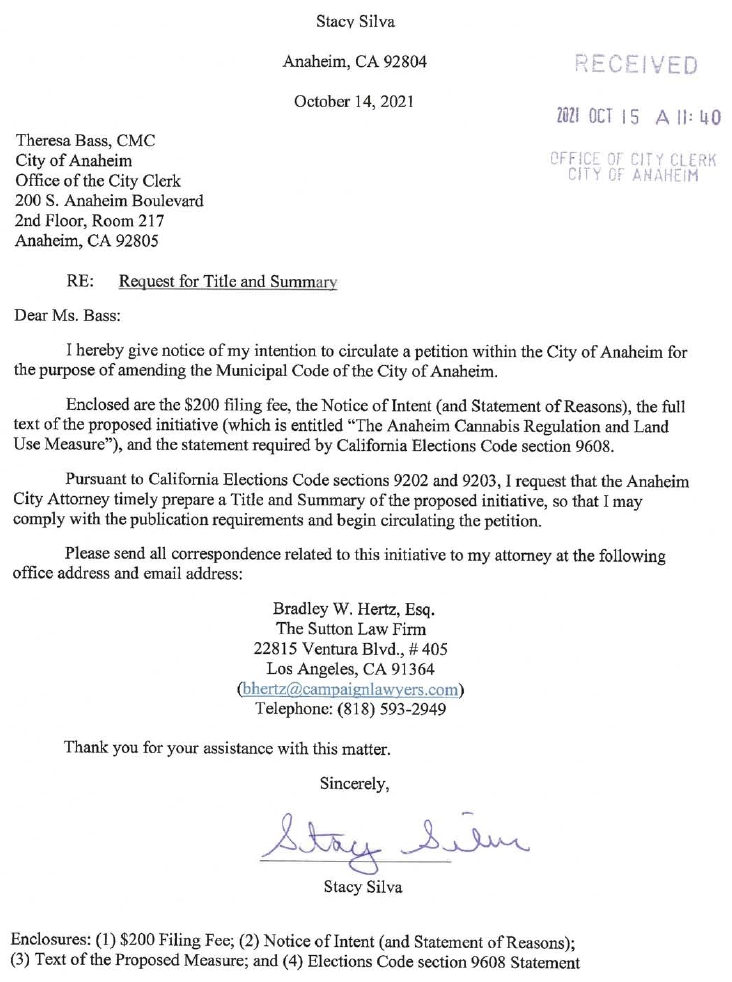
The Silva petition.
On Friday, October 15, 2021, the Anaheim City Clerk received a letter from Stacy Silva declaring that it was her “intention to circulate a petition” to gather signatures to put an initiative on the ballot entitled “The Anaheim Cannabis Regulation and Land Use Measure.” She filed all the required paperwork and paid a $200 filing fee. Silva instructed the city clerk that all correspondence be sent to her lawyer at his Woodland Hills office.
Silva’s lawyer was Bradley Hertz, an election law attorney who had done work for Ament. A Form 410 filed with the city clerk’s office on September 26, 2018 reveals he was treasurer of an independent expenditure committee called “No on L, a Project of the Anaheim Chamber of Commerce,” which spent $932,053 in an unsuccessful attempt to defeat a measure which raised the wages of workers of hotels that received tax subsidies.
The text of the initiative Silva submitted was mostly a copy of the cannabis ordinance championed by Ament, Flint, and Sidhu in 2020. However, there were exceptions. First, the number of permitted cannabis retailers allowed to operate in the city was increased from from 20 to 30; one single entity could control up to five of them, instead of three. Second, the requirement workers be full-time to qualify for a labor peace agreement was scrapped.
Herein lies the “smoking gun” of UFCW Local 324’s alliance with the Anaheim Chamber of Commerce to legalize cannabis businesses. They first tried to pass an ordinance through the council, but failed. Now there was evidence they were collaborating on a ballot initiative. However, there is a catch. Ament had resigned before Silva filed her paperwork with the city clerk. That begs the question: who took his place?
Regardless of what the case might be, Silva withdrew her initiative on October 28th claiming it needed “minor edits.” Then she submitted a new version on November 22nd, which reinstated the requirement workers be full-time to qualify for a labor peace agreement. But after December 7th, everything stopped. When The Investigator asked City Clerk Theresa Bass what happened, she said Silva didn’t continue the filing process.
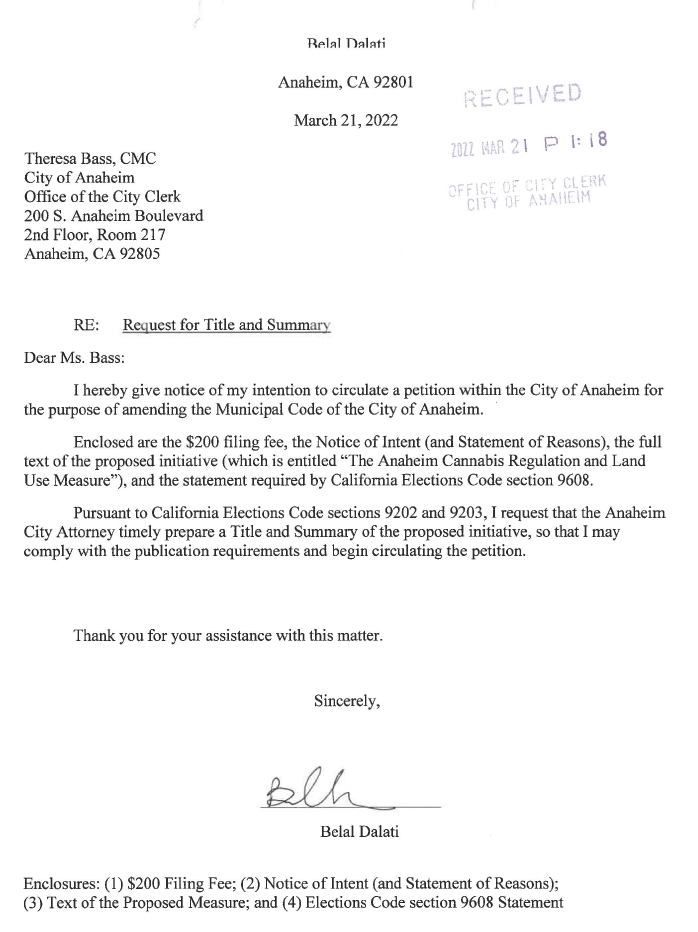
The Dalati petition.
Three months later, a new face appeared. Belal Dalati, a local real estate agent, walked into the city clerk’s office on Monday, March 21, 2022 with a letter notifying them it was his “intention to circulate a petition” to gather signatures to put a cannabis initiative on the ballot. Most of the paperwork he filed was identical to Silva’s. He used the same title, preamble, and law firm as a contact. But the text of the initiative was different.
Unlike Silva’s initiatives, Dalati’s came from Adam Spiker, of Spiker Rendon Consulting, Inc., a cannabis industry lobbyist located in downtown Los Angeles. The initiative he touted was very “pro-labor.” Not only did it drop the requirement workers be full-time to qualify for a labor peace agreement, but a points system was set up to give preferences to applicants of city licenses who had good employee and community benefits plans.
By May 16th, Dalati changed his mind. At the urging of Bill Taormina and Paul Kott, two local businessman who were opposed to legalizing cannabis businesses, he withdrew his initiative. In a text message Taormina sent to Councilman Trevor O’Neil, he alleged that “Bill Dahlati [sic] was forced into filing the petition by Jeff Flint and other ‘dope dealer’ promoters. He was actually threatened by them not to withdraw the petition ….”
In the days and weeks that followed, the public would learn–thanks to FBI affidavits released in court filings–this scandal wasn’t just about Sidhu and the stadium deal. At the very heart of it was Melahat Rafiei, a political consultant and Democratic Party operative, who is alleged to have committed various crimes in connection with the Anaheim Chamber Of Commerce’s attempt to legalize cannabis businesses.
However, in writing this article, The Investigator made a decision to mostly stay away from Rafiei. Why did we do this? First, her name didn’t pop up in anything having to do this story. Second, the FBI affidavits that have been released so far offer an incomplete and distorted view of what transpired. Third, the testimony offered in those affidavits are solely focused on proving violations of federal criminal laws. It doesn’t talk about what was legal.
Besides Rafiei, it’s erroneous to presume that everybody who worked along with Ament, Flint, and Sidhu to legalize cannabis businesses broke the law. Nothing can be further from the truth. The reality is, an overwhelming majority of people that ended up being dragged into this affair–including pretty much everybody we mentioned in this article–are innocent of any crimes. They are what we would call “victims of circumstance.”
The Investigatorknows despite our good faith efforts to gather accurate information for this article, what we have written isn’t the full story. And it’s possible a few corrections will need to be made as we learn more. But what’s important is we have exposed the biggest “secret” of this scandal: UFCW Local 324‘s alliance with the Anaheim Chamber of Commerce to legalize cannabis businesses. And it implicates Democrats and Republicans.
The political ramifications of this “secret” are political dynamite. For example, during last year’s election, in order to win the endorsement of the Orange County Register, then-candidate Aitken told the editors “the former mayor and his tightly knit ‘cabal’ were allowed to run roughshod at City Hall, and created a culture of intimidation for staff, management, concerned residents, and the smaller business community.”
What Aitken neglected to mention is UFCW Local 324, a major union of whom she has had close ties to since 2018, was involved in a “pot deal” with the same “former mayor and his tightly knit ‘cabal.'” Though there is no evidence of any criminal wrongdoing, it does vastly complicate things. Maybe she didn’t know about it, but giving $350 worth of city-owned tickets to Smith, their political director, won’t help her in any pleas of innocence.
For matter of record, The Investigator asked for interviews or sent questions outto Belal Dalati, Harry Sidhu, Derek Smith, Stacy Silva, Adam Spiker and others we believed had knowledge about this matter. Most didn’t answer our emails or reply to voice messages. One person declined to speak citing ongoing “local and federal investigations.” Ashleigh Aitken ignored our request for comment on the Anaheim Ducks tickets she gave to Smith.
The job offer was set into motion shortly after Valencia sent out an email to James Vanderpool, the city manager, on Monday, July 26, 2021, expressing that he “would like to hire Dr. Tina Arias Miller as a Senior Policy Aide…. Dr. Miller will be working about 6-7 hours a week. Her hourly compensation will be $31.00 an hour.”
Valencia’s email to the city manager.
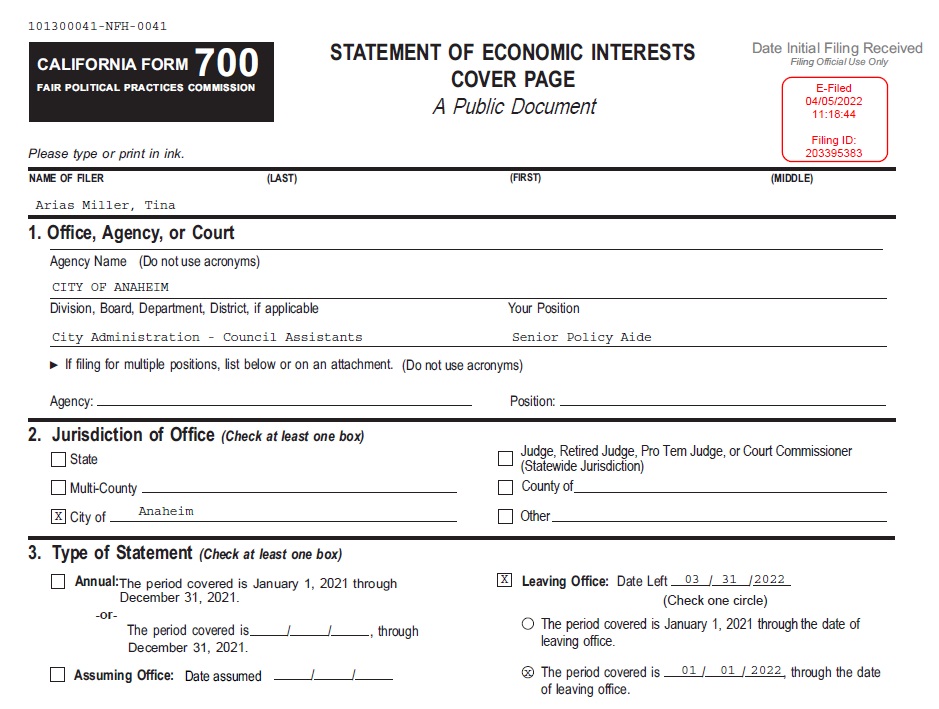
Documents The Investigator acquired from the City of Anaheim show that Miller worked for Valencia less than a year. A human resources action report notes she was hired on August 16, 2021. And her last day on the job was March 31, 2022, according to the final Form 700 Statement of Economic Interests that she filed.
However, it’s unclear what Miller did for the councilman that warranted her higher pay grade. For example, The Investigator carefully reviewed his calendar during the several months he employed her and though she was sent to a few city meetings, she appears to have spent most of her time doing tasks that lesser-paid council aides do.
But most importantly, Valencia took steps to ensure the public never knew he had hired her. At no time did he ever list Miller’s name on his homepage on the city website. And despite the fact she had an official email address, she was apparently told not to use it to send messages, enabling her to elude detection from public records act requests.
Valencia has known Serrano since 2018. Sources have alleged the two used to “hang out” together at the Santa Ana Police Officers Association headquarters quite often. Furthermore, they claim Serrano was a guest at his wedding to MonicaMungia, who is employed as a principal with the Anaheim Elementary School District.
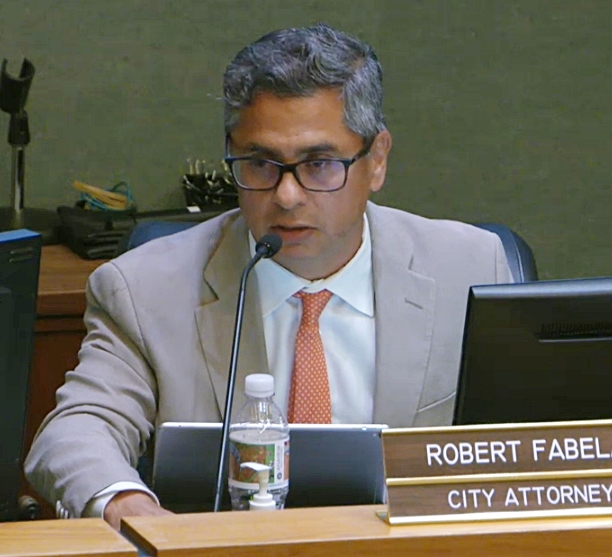
Robert Fabela, City Attorney for the City of Anaheim, speaking at a meeting of the Anaheim City Council earlier this year.
By DUANE ROBERTS Editor & Publisher
In a highly unusual chain of emails obtained from the City of Anaheim last year through the public records act, City Attorney Robert Fabela appears to have advised Councilman Avelino Valencia III to “lie” to The Anaheim Investigator about the underlying reasons why he handed out several thousand dollars worth of city-owned Angels baseball tickets to his campaign backers–something of which the city attorney has emphatically denied.
The emails in question, which were also shared with City Clerk Theresa Bass and Chief Communications OfficerMike Lyster, offers a rare glimpse into a system that holds nobody accountable for misusing any of the hundreds of tickets the city gets each year from Angel Stadium and Honda Center, allowing politicians like Valencia to give them away like candy to big donors, personal friends, and union leaders who helped get him elected.
In an attempt to learn more about the “good work” these people did, The Investigator sent Valencia an email on June 17th which listed the names of 22 individuals that public records showed were the recipients of his ticket largess between the months of April and May. “In the interest of full public disclosure, [we’re] requesting information as to the type of ‘volunteer public service’ each of the above persons are engaged in,” we wrote.
It wasn’t until in mid-July The Investigator learned Valencia was concerned about our inquiry into the reasons why he gave out tickets. A chain of emails obtained through the public records act showed that shortly after receiving our June 17th message, the councilman forwarded it to Fabela and Bass, asking them for help. “Please see the below email I received,” he said. “I would appreciate your advise [sic] and direction regarding the request.”
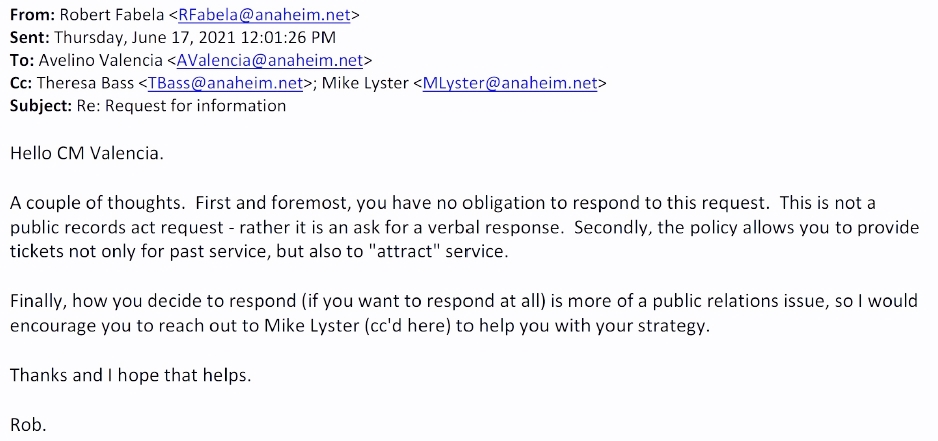
Within a half hour, Fabela issued a reply. The city attorney told Valencia he had “no obligation to respond” to The Investigator because it was “an ask for a verbal response.” Furthermore, he stated “policy” allows the councilman to “provide tickets not only for past service, but also to ‘attract’ service.” And finally, Fabela said if he does choose to respond, that this is “more of a public relations issue,” urging him to contact Lyster “to help him with … strategy.”
Forty minutes later, Bass followed up with an email backing one of Fabela’s points. “For reference, I am attaching a copy of our Ticket Policy — Section 5.0 states the conditions by which tickets may be distributed,” the city clerk told Valencia. “As noted by Rob, the policy allows for ‘attracting or rewarding volunteer public service’ which was noted on your Form 802, meeting the requirements of the policy and FPPC Form 802.”
Fabela’s email to Valencia.
The chain of emails The Investigator discovered–especially the one sent out by Fabela–offers us a behind-the-scenes look into why the ticket system has been constantly plagued with cronyism and corruption. Though part of problem lies with bad policies that have allowed council members to hijack it for political purposes, evidence we have unearthed seems to hint an overly compliant city bureaucracy might also be enabling this unethical behavior.
That Valencia sought advice from Fabela on how to respond to The Investigator’s email is in itself amusing. After all, the councilman had already gone on record at the June 8th meeting as saying he just gave tickets to “public members who were doing good work for the community.” Since all we requested was that he provide us with information as to the type of “good work” they did, why was there a need to consult the city attorney?
But it is what Fabela instructed him to do that is of great significance. Besides the fact he told Valencia that he could ignore The Investigator–and thus stonewall our inquiry–it appears he advised him to “lie” about the reason why he handed out those tickets, reminding the councilman that “policy” also allows him to “provide tickets … to ‘attract’ service”–a flimsy pretext which doesn’t require recipients to do any “volunteer public service.”
To better understand the context of Fabela’s advice, it was given after the councilmanhad already handed out tickets to 22 individuals–most of them campaign backers–between the months of April and May. And by reminding Valencia that “policy” also allows him to “provide tickets … to ‘attract’ service,” the city attorney hinted a different pretext could be used to justify what he did, thus “lie” about his reasons for distributing them.
What is most revealing about Fabela’s email is he never advised Valencia to truthfully answer The Investigator’s questions. Given that taxpayers own these tickets, one would think the city attorney would zealously guard their interests. Not so. Everything he wrote, whether intentional or not, encouraged the councilman to be deceptive. Even his suggestion Lyster be contacted to formulate a response hinted it be a spun narrative.
The emailthat Bass sent out, however, was more straightforward. The city clerk was correct when she told Valencia “policy allows for ‘attracting or rewarding volunteer public service’ which was noted on your Form 802, meeting the requirements of the policy and FPPC Form 802.” There is nothing on ticket disclosure forms which require council members to explain why they gave them away. But they do have to identify a “public purpose.”
A Form 802 that Valencia filed in April 2021.
It is not a strange coincidence that on every Form 802Valencia filed for each big donor, personal friend, and union leader that he gave city-owned Angels baseball tickets to, he listed “attracting or rewarding volunteer public service” as the “public purpose.” That’s because this “public purpose,” as it is currently written, contains a major loophole which enables council members to hand out tickets to anybody on a flimsy pretext.
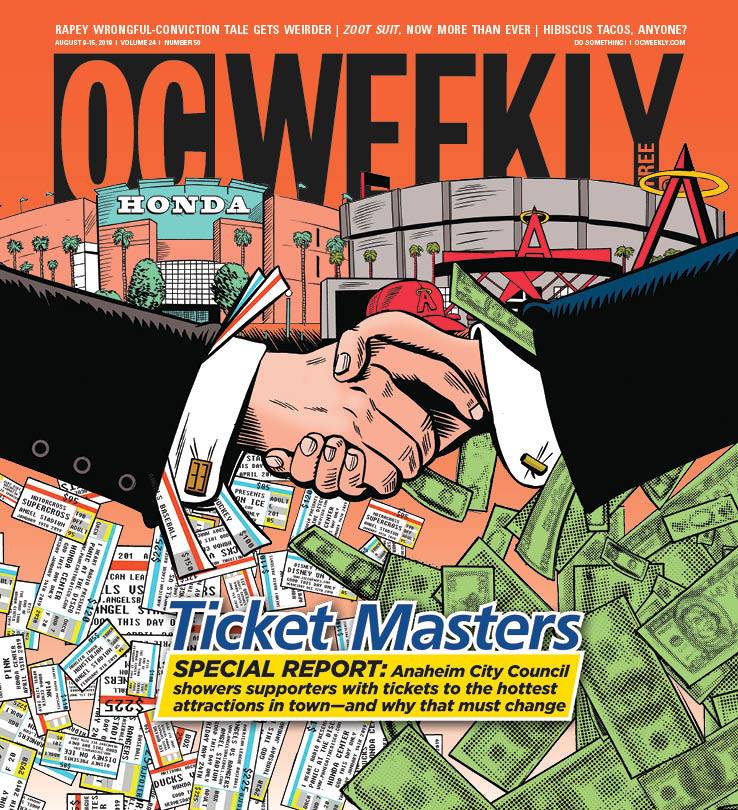
This loophole was first noticed by Gabriel San Roman, a former investigative journalist for the defunct-OC Weekly. While reviewing more than 1,539 ticket disclosure forms in 2019, he discovered a common pattern among council members who were abusing the system for their own selfish motives: they noted on each Form 802 they filed that they gave away tickets for the “public purpose” of “attracting or rewarding volunteer public service.”
Upon further scrutiny, San Roman learned this “public purpose” allowed council members to disburse tickets for two entirely different reasons: they can give them to “reward” people for “volunteer public service” they have done; or give them to “attract” people to do “volunteer public service” in the future. Since council members aren’t obligated to explain why they gave them away, nobody ever knows which of these two they chose.
The ambiguous nature of this “public purpose” has created a loophole which council members have been all too eager to exploit: if tickets can be given away to “attract” people to do “volunteer public service” in the future, then the recipient doesn’t have to do anything to earn them. Over the years, this flimsy pretext has paved the way for doling them out to practically anybody–big donors, lobbyists, political operatives–you name it.
OC Weekly cover story on August 9, 2019.
For matter of record, The Investigator did reach out to Fabela seeking his comment for this article. We asked the city attorney point blank if in the advice he gave to Valencia that he was “encouraging him to be deceptive—if not ‘lie’ to us—should he have chosen to respond” to our inquiry requesting he provide “additional information about his reasons for handing out tickets to 22 people during the months of April and May 2021”
“The answer to your question is ‘no’ as your inquiry is based on a misreading of both the email and the City ticket policy,” said Fabela. “The question to the Council member incorrectly assumed that past public service is the only criteria allowed under the City’s ticket policy, and my email to the Council member corrects that and reflects what City policy actually states. I do not see how that could be interpreted as encouraging anyone to ‘lie.'”
Regardless of what the city attorney’s intent was, it’s quite evident that Valencia felt empowered by what he said to continue distributing tickets to campaign backers without fear of any repercussions. Though the councilman has been handing more of them out to local residents and non-profit groups, he still doles tickets to cronies who not only have helped get him elected to public office in the past, but will probably do so in the future.
Below is the chain of emails set into motion by The Investigator’s inquiry into the recipients of Councilman Avelino Valencia’s tickets on June 17, 2021.
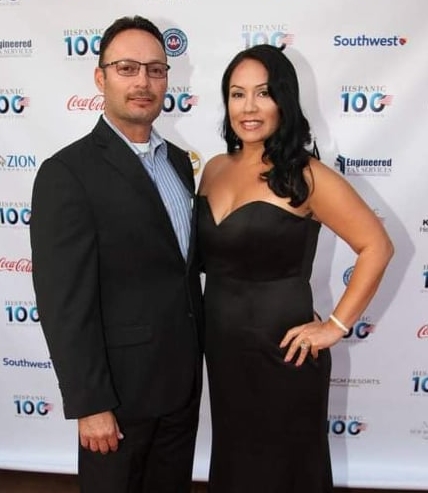
Gerry Serrano (left), President of the Santa Ana Police Officers Association, with Serina (right), his wife, at an event in Newport Beach in 2017.
By DUANE ROBERTS Editor & Publisher
In 2019, when Gabriel San Roman, a former investigative journalist for the defunct-OC Weekly, reviewed more than 1,539 ticket disclosure forms—Form 802sas they are called—to see who received the thousands of dollars worth of tickets the city got each year from Angel Stadium and Honda Center, he noticed an unusual practice: some council members were trying to avoid publicly disclosing the identity of persons they were really giving tickets to by reporting that they gave them to their spouse instead.
For example, San Roman discovered that then-Councilman Jordan Brandmanhad given city-owned tickets valued at $900 to Carrie Nocella, a lobbyist for The Walt Disney Company. But on the Form 802 that was filed, he stated those tickets were meant for Tom Nocella, her husband. Brandman had a ready-made excuse. “Tom is a longtime Anaheim resident,” he said. “Like all other council members, I regularly recognize numerous residents, community groups and city employees by behesting them tickets …”
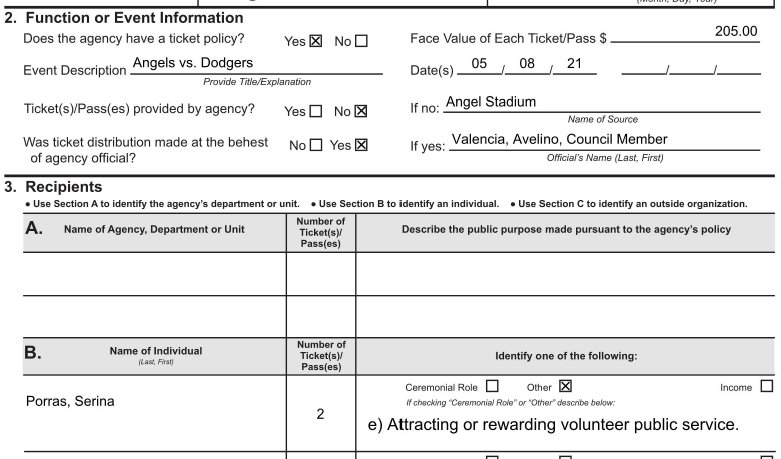
But documents The Investigator obtained under the California Public Records Act show Valencia may have tried to go further than this. An earlier Form 802 the councilman submitted offers prima facie evidence suggesting he made an attempt to hide Serina’s identity from public disclosure by using Serina Porras, her maiden name, instead of Serina Serrano, her married (and legal) one. If this form had been officially filed with the city under her maiden name, it would have been much harder to link her to Gerry.
Screenshot of the withdrawn Form 802 with Serina’s maiden name.
In a followup message, Torres told Serina that he got this information directly from the councilman. “I was unaware that we had your old name filed,” he typed. But in a stunning admission, he acknowledged to Serina he knew what her legal name was: “Frankly, I used Serina Serrano for this email thread because that was your apparent name based on your email address.” Indeed, The Investigator has an unredacted copy of her personal email address and can confirm he was using it to communicate with her.
Though Torres would later claim Valencia was “unaware of the name change,” all of this begs the question of how he knew Serina’s maiden name was Porras? Furthermore, the councilman himself most likely provided his city council assistant with her personal email address. Wouldn’t it be reasonable to assume since that email has Serrano as her last name, that’s how she identifies herself? Perhaps it should be noted she uses it as a last name on all of her identifiable social media accounts as well.
Under California state law, there are criminal statutes—specifically Penal Code 115—which make it a crime to file a false Form 802 with a government agency. For example, if a person knowingly files a document that contains inaccurate information, they could face a felony charge. However, a document has to have been officially filed with an agency before a prosecution can take place. That didn’t happen in this situation. The Form 802 in question was withdrawn and quickly replaced with a corrected version.
Regardless of what Valencia was trying to do, he definitely had a motive to conceal his ties to Gerry Serrano. Not only has the latter been a controversial and divisive figure in Santa Ana politics, but he has been subject of multiple investigations into alleged misconduct by local, state, and federal authorities–including reportedly being the target of a grand jury probe. The councilman’s squeaky-clean image would undoubtedly be tarnished if he was caught handing out tickets to such a troubled individual.
For matter of record, The Investigator emailed Valencia approximately three times requesting comment for this article. We wanted to know the reason why he felt motivated to use Serina’s maiden name on the original Form 802 he submitted, then later withdrew due to her questioning why it was being used. We were hoping that his reply would put our concerns about this matter to rest. But so far, the dapper councilman from District 4 hasn’t bothered responding to any of the messages we sent him.
Will you make a small $5 gift today? Your contribution will allow The Anaheim Investigator to keep delivering hard-hitting investigative journalism that’s open for everyone to see! Nobody covers Anaheim City Hall like like we do. That's why your support is so important to us!






















 anaheiminvestigator.com