
State Treasurer Aided Gondola Firm Seeking Government-Backed Loan Guarantee from Bank She Oversees

James Vanderpool, City Manager of Anaheim, and Fiona Ma, State Treasurer of California, at a restaurant bar in March 2017.
By DUANE J. ROBERTS
Editor & Publisher
The Anaheim Investigator has obtained internal emails, letters, reports, and financial forms showing that State Treasurer Fiona Ma—who is currently running for Lt. Governor–quietly aided Swyft Cities, a crowdfunded high-tech startup based in northern California, encouraging it to seek state financing for its projects, especially a loan guarantee from a public bank she oversees.
The aforementioned documents, all gathered through public records act requests filed with multiple local and state agencies, also reveal a key investor in this firm has known Ma since 2012, and that she is “actively engaging in her network [of contacts] on the company’s behalf,” which, according to one unusual email, includes James Vanderpool, the city manager of Anaheim.
Moreover, they also indicate that Ma’s involvement might have strayed into territory where her public authority and private relationships intersected in ways which raise clear conflict‑of‑interest concerns. That overlap becomes even more apparent as they trace how her actions factored into Swyft Cities rush to secure public‑sector contracts before the 2028 Summer Olympics.

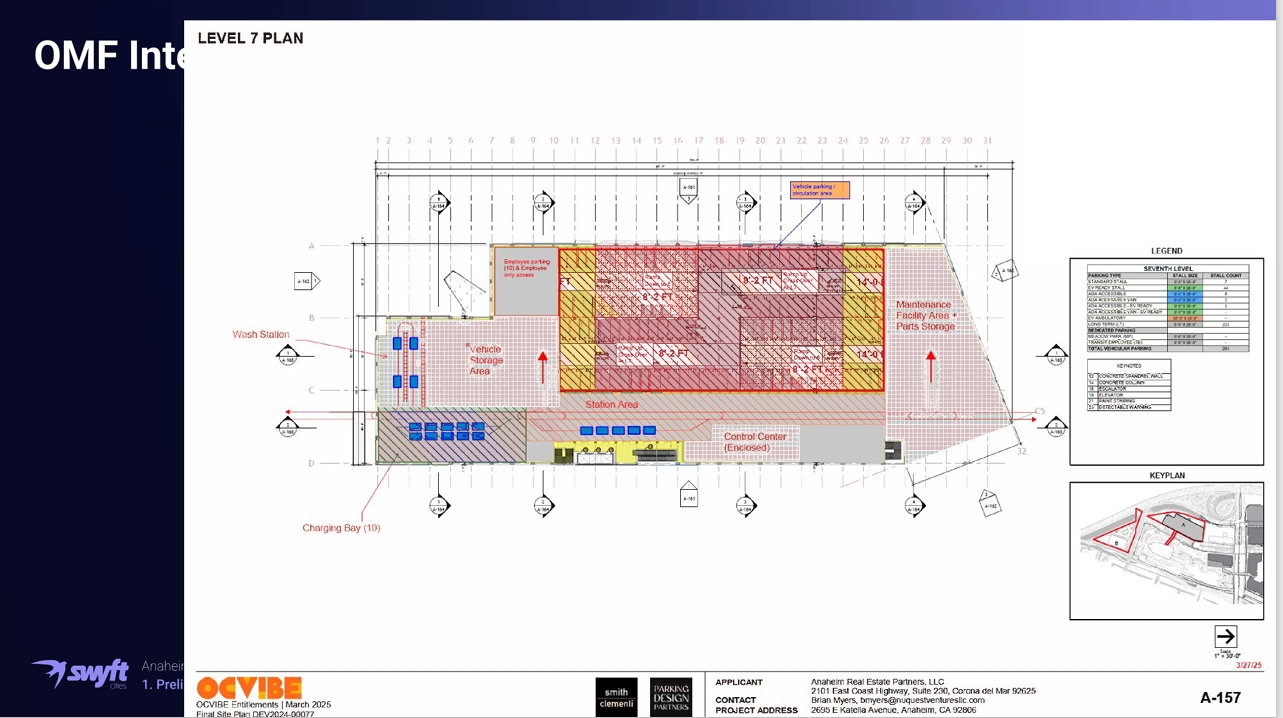
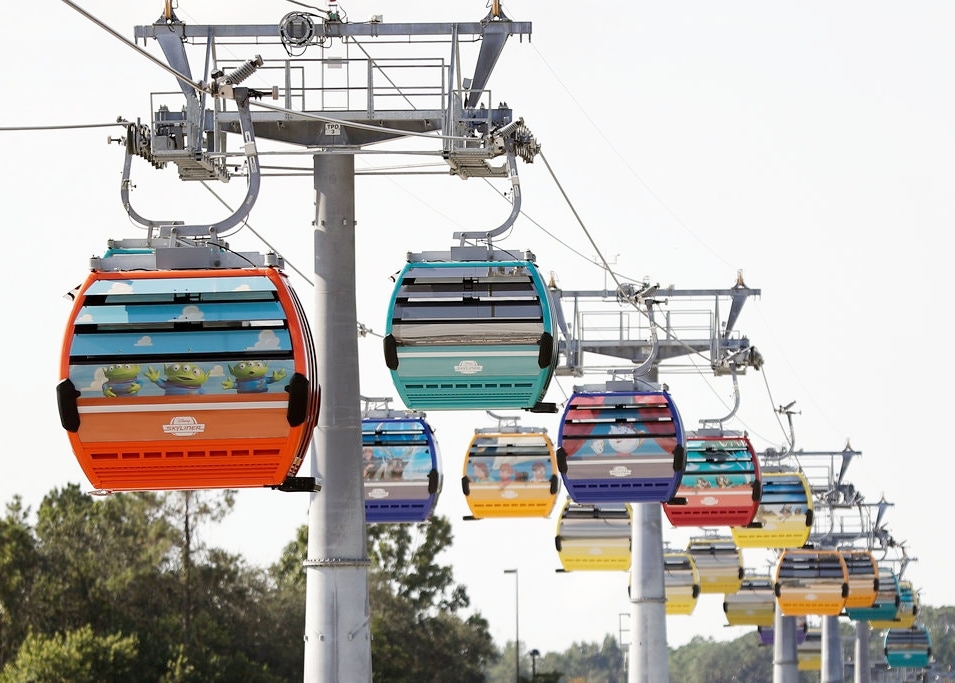
Concept image of aerial gondolas next to a future OCVibe parking garage.
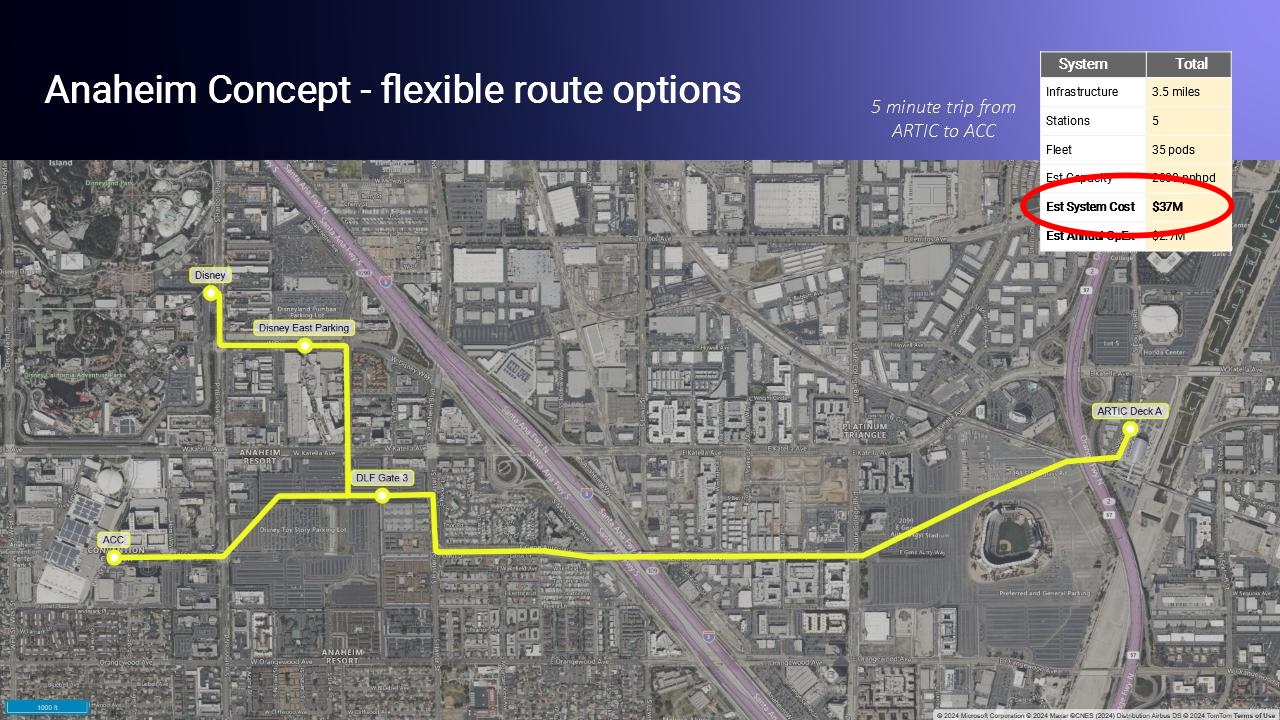
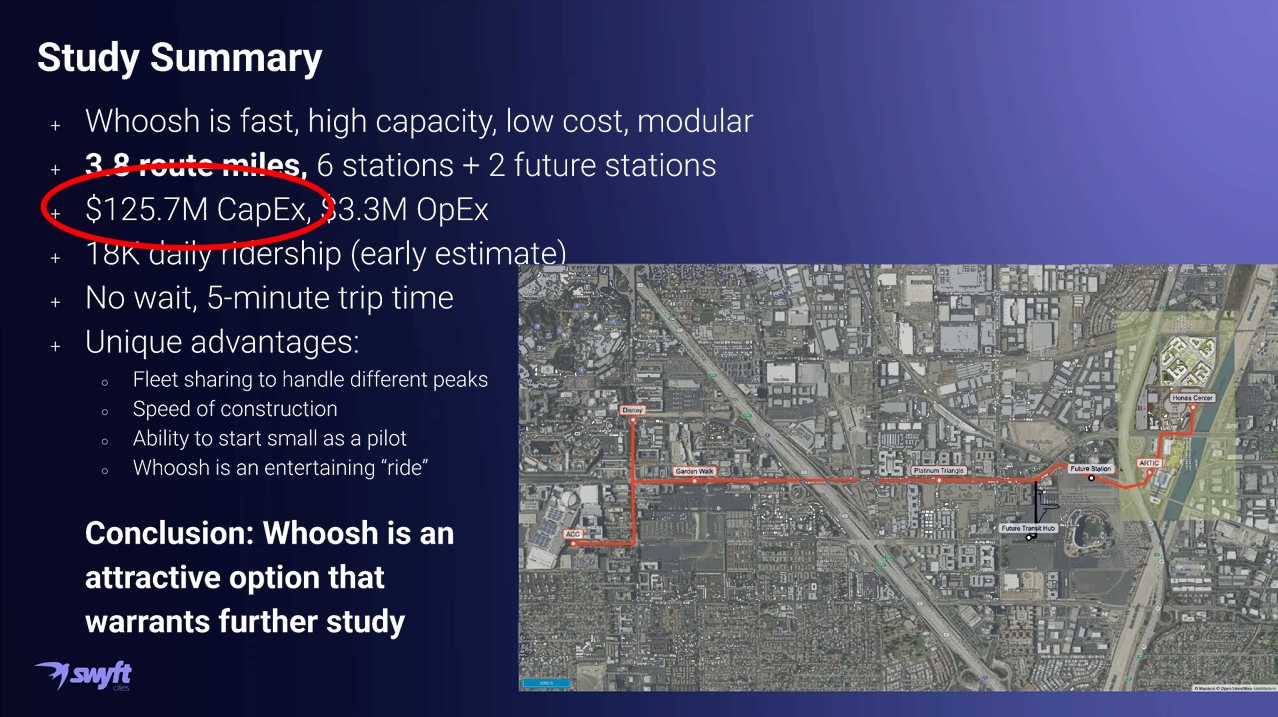
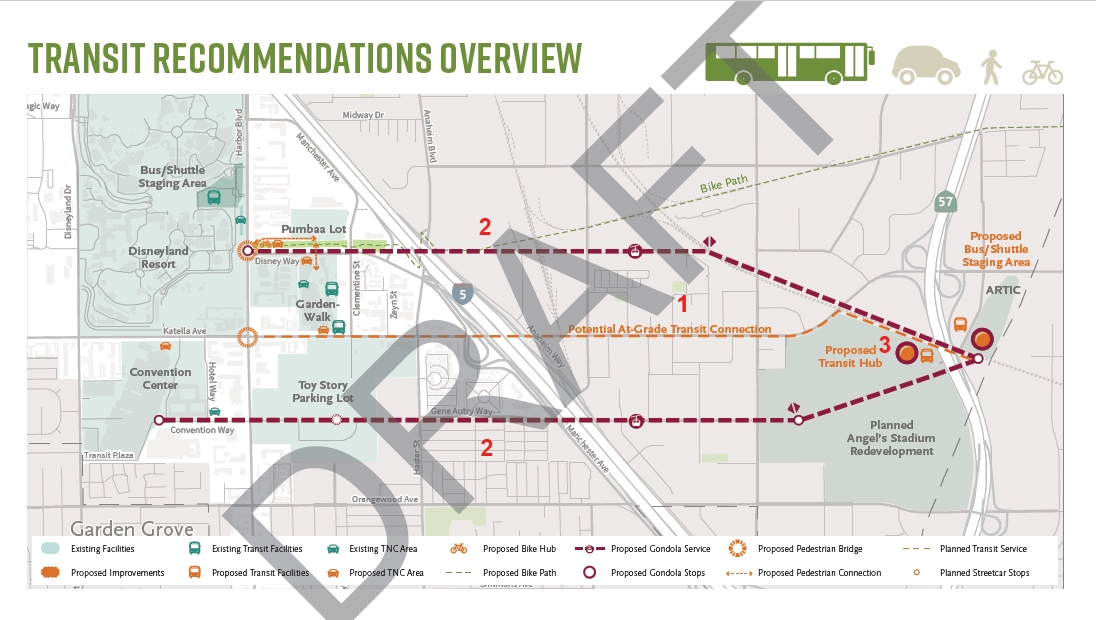
Last September, The Investigator reported city planners had been working with Swyft Cities to explore building an aerial gondola system linking the Platinum Triangle to the Anaheim Resort. Evidence available then—including a schedule embedded in a PowerPoint presentation—suggested that the project was being strategically timed to coincide with the Olympics.
But what was not disclosed is that we had secretly launched a major investigation into a highly unusual email we discovered buried among dozens of communications which strongly hinted that an elected statewide officeholder may have been inappropriately exercising their power to influence government decisions solely on behalf of a private company.
That email, sent by Jeral Poskey, founder and CEO of the firm, was directed to Rudy Emami, the city’s public works director, on January 17, 2025. In it, he said “that California State Treasurer Fiona Ma was at our office this morning, and a few minutes ago she copied me on a message to Jim Vanderpool. She is highly supportive. Rudy, I expect you might get some questions from Jim.”
Though the law does not prohibit an elected statewide officeholder like Ma from expressing support for a local project, the boundary between ordinary advocacy and improper influence becomes indistinct when that support is conveyed privately to city staff in ways that could shape government decisions outside established public channels and undermine public trust.
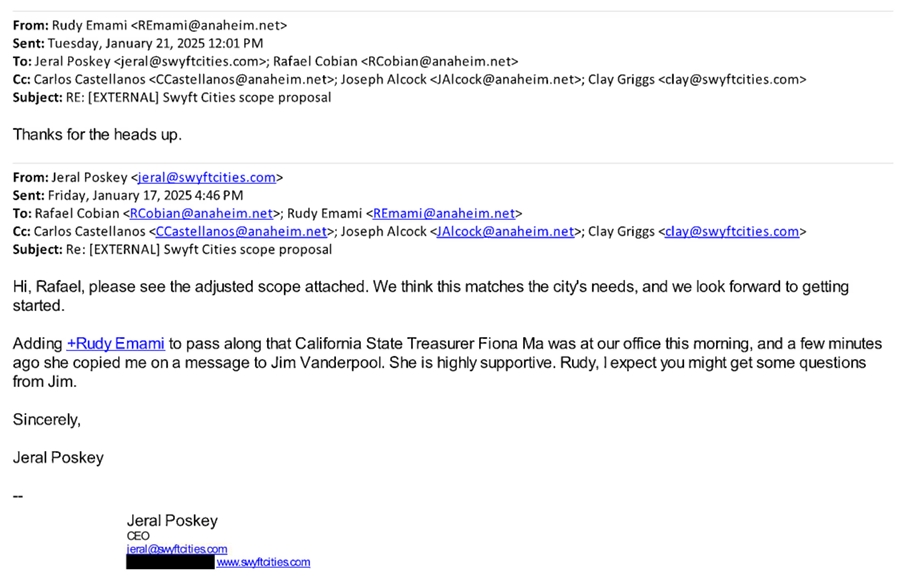
Jeral Poskey’s email mentioning Ma and Vanderpool on January 17, 2025.
Several emails released by the state treasurer’s office under the public records act confirm that Ma not only traveled to Swyft Cities‘ office in Palo Alto to meet Poskey on the morning of January 17th, but also with Laura Fingal-Surma, founder of Urbanist Ventures, a “startup studio and angel fund” based in San Francisco that has provided seed money for the firm.
The meeting was arranged by Nick Garzilli, another key investor. Though it’s not clear if he was present, there may be a reason why he was chosen to set it up: he is an acquaintance of Ma. “I’ve known Fiona since 2012,” Garzilli boasted to an Irish film producer, “and recently she has been helping us meet the right people to build Swyft Cities. We are making some great progress.”
The Investigator filed public records act requests with the Anaheim city clerk and the state treasurer’s office asking for a copy of the email between Ma and Vanderpool that was sent to Poskey. But both agencies claimed that after “conducting a thorough and diligent search,” they couldn’t find it, asserting instead that there were simply no responsive records.
However, that message exposed a secret only Ma would know: Vanderpool is a longtime friend of hers. The Investigator has photos of them at bars, social gatherings, and events going as far back as 2015. Sometimes he has invited her to attend sports events with him using city-owned tickets. And they communicate often via text message about business pertaining to Anaheim.
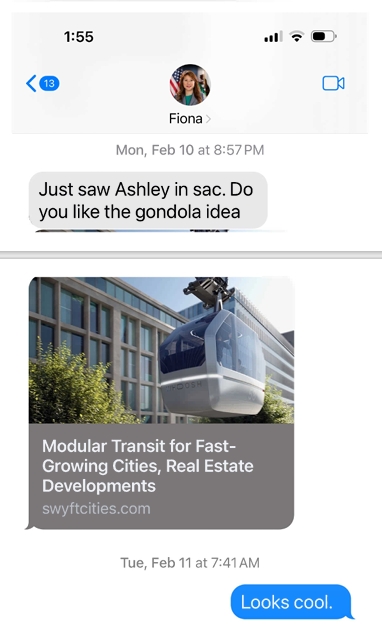
Ma texting Vanderpool about Swyft Cities on February 10, 2025.
The Palo Alto meeting isn’t the only one Garzilli organized with Ma’s apparent blessing. A January 23rd email shows he tried to set one up between Carol Folt, then-president of the University of Southern California, Paul Krekorian, executive director of the Office of Major Events, who works for Los Angeles Mayor Karen Bass, and the state treasurer herself.
The reason? To discuss building an aerial gondola system that would travel from USC to Exposition Park and completing it before the opening ceremonies of the 2028 Summer Olympics. “My dream would be to get it on campus, the surrounding community, and all the way around the Coliseum, Lucas Museum, Natural History, CA Science Center…,” Garzilli said.
Roughly two weeks later, another email shows that he succeeded in convincing Folt to schedule a meeting on February 19th at 10:00 a.m. But the names of possible attendees had changed. Andrea Ambriz, general manager of Exposition Park, was in. But Krekorian, for whatever reason, was out. And Ma was now listed as someone who had just helped arranged the meeting.
Perhaps in lieu of Krekorian’s absence, Garzilli contacted Los Angeles City Councilman Marqueece Harris‑Dawson and invited him to come to the meeting instead. Besides serving a district that borders USC and Exposition Park, the councilman is president of the city council and chair of the Ad Hoc Committee on the 2028 Summer Olympics and Paralympic Games.
It is not known if Councilman Harris-Dawson attended this function. The Investigator filed a public records act request with his office last month and is still waiting for a reply. A request is also pending with the Office of Exposition Park Management, an agency run by the state. The Office of Major Events responded by releasing a copy of the email they received from Garzilli.
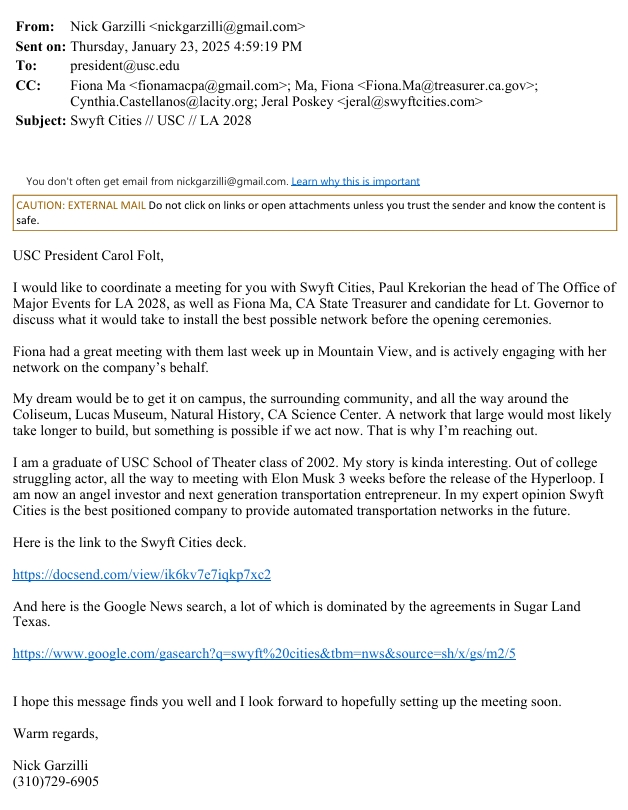
Nick Garzilli’s email to then USC President Carol Folt on January 23, 2025.
In a slide included in a PowerPoint presentation Swyft Cities released in July—commissioned by the City of Anaheim for $20,000—the firm stated that funding for its aerial gondola systems might be drawn from three prospective sources: the California Infrastructure & Economic Development Bank (IBank), competitive grants, and public‑private partnerships.
It is the latter that Devon Mathis has expertise in. According to his LinkedIn biography, he is Director of Government and Public Relations for Origyn International, an energy company which provides and maintains public infrastructure for cities at absolutely no upfront cost. In return, they pay for it slowly through a long‑term service agreement rather than carrying debt.
Mathis is also part of Ma’s network of contacts. His name surfaced in emails between Swyft Cities and the City of Irvine during a conversation about one way they might be able to finance an aerial gondola system that they want to build for the Great Park, a 1,300‑acre recreation hub taking shape on land previously occupied by the El Toro Marine Corps Air Station.
“I want to introduce you to Devon Mathis of Origyn,” Poskey wrote in a March 31, 2025 email to Sean Crumby, then the city’s director of public works. He described Mathis as a former California state representative “recommended by Treasurer Fiona Ma” and said he wanted to meet “to show how they can finance the construction and operation of a [gondola] system like Whoosh …”
Mathis, much like Vanderpool, has enjoyed a long personal and professional relationship with the state treasurer. Both appear together in photos at public and private events. A letter of recommendation released through a public records act request shows Ma characterizing him as “someone I’ve come to know and respect through years of working together in the Capitol.”

Devon Mathis with his daughter and Ma in 2021.
As noted earlier, Swyft Cities listed IBank as another potential source of funding. But it is not a private bank. It is a public one that issues bonds and provides low‑cost loans for infrastructure, climate, and economic development projects. It helps fund everything from water systems and public facilities to clean‑energy and community development initiatives.
The IBank is housed in the Governor’s Office of Business and Economic Development (GO‑Biz). Four of the five board members are gubernatorial appointees—the GO‑Biz director, the director of finance, and two public members—and Ma serves on the board ex officio as an elected official with the power to help approve or deny loans for projects that come before it.
Emails that The Investigator obtained from IBank under the public records act show Swyft Cities was in direct communication with their staff to learn more about what financing options were available to them. “Fiona Ma directed us to look through the IBank, CalCAP, and SBA programs,” Steve Raney, a Systems Planner, told a senior loan officer in a message dated April 23, 2025.
“Swyft Cities is interested in a loan guarantee … We need to very, very quickly develop project financing options for the first phase of a two-phase smart gondola infrastructure project,” he said. “The customer is the City of Irvine Great Park (IGP), a nonprofit organization with a $1 billion redevelopment budget, funded by a Mello-Roos tax on adjacent homes.”
The Irvine Great Park Board had just voted 5–1 the previous day to enter negotiations with Swyft Cities on a proposed aerial gondola system, but the approval came with some conditions. The firm had to prove it could deliver a $10 million pilot project with no public funds and demonstrate it had the financing and operational capacity to make the system fully viable.
Raney informed the loan officer he believed “that the Climate Tech Finance loan guarantee program is the most effective,” for his firm,”but it may be flawed.” IBank staff responded by putting him in touch with the Bay Area Air District (BAAD), a public agency which does much more than just regulate stationary sources of air pollution across the San Francisco Bay Area.
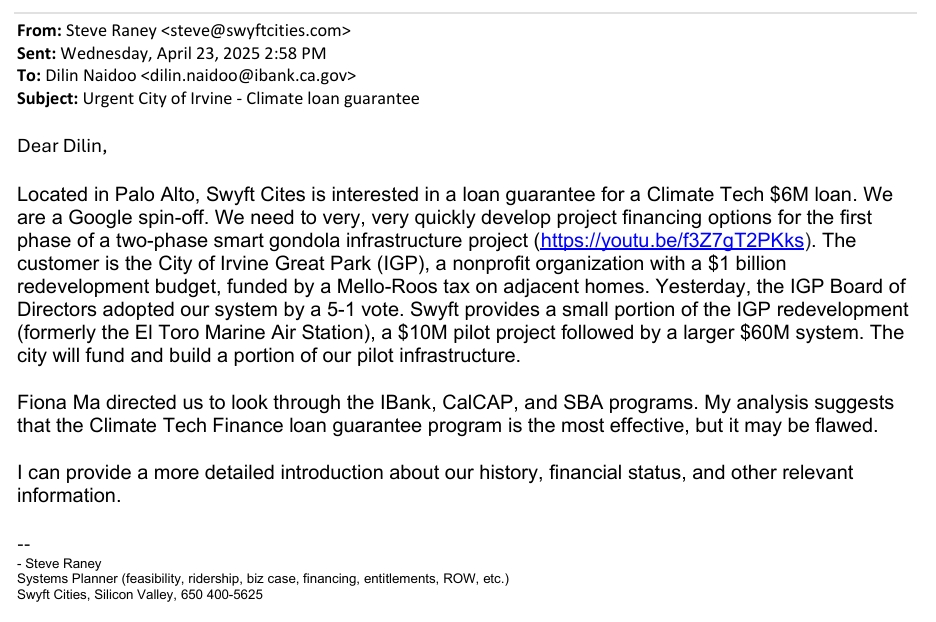
Steve Raney’s email to an IBank loan officer on April 23, 2025.
BAAD plays a little known, but specialized, operational role with the IBank through a joint program called Climate Tech Finance. Established in 2018 to accelerate the development of new and innovative technologies that reduce greenhouse gases, a team at this agency essentially prepares, vets, and funnels eligible applicants directly into their financing pipeline.
Once an applicant qualifies, the IBank then provides a government‑backed loan guarantee that reduces lender risk and unlocks financing for early‑stage climate‑tech firms. By promising to cover most losses if a borrower defaults on their payments, the state makes private financial institutions willing to fund companies that they would otherwise reject as too risky.
Emails released to The Investigator by BAAD show that Swyft Cities sought a quote for a $2 million loan guarantee in December 2024 but didn’t follow through with the required paperwork to start the application process. However, they started again shortly after the Irvine Great Park Board voted in favor of entering into negotiations with them to build one of their systems.
An April 24th email shows Raney filled out their online form and requested another quote, this time for $6 million, claiming the City of Irvine would front around $4 million. Asked to “Describe the climate technology,” he typed, “300 MPGe smart gondola: low embedded carbon, enables low GHG land use.” To “When is the money needed,” he replied, “Within a month.”
However, Swyft Cities didn’t get the cash. Monthly activity reports written by a private consultant retained by BAAD show their request proceeded very slowly. Though the firm had chosen Gondola Ventures, a “hybrid venture and private equity firm” based in Washington, as their preferred lender, the agency spent months trying to arrange a meeting to determine eligibility.
“We are [still] attempting to set up a meeting to evaluate the lender (Gondola Ventures) which has expressed strong interest in them,” the consultant wrote in an August 2025 activity report. “We are reviewing the possibility of certifying them as a nonbank lender for the Swyft Cities project.” Then he cryptically added: “The IBank leadership knows Gondola Ventures.“
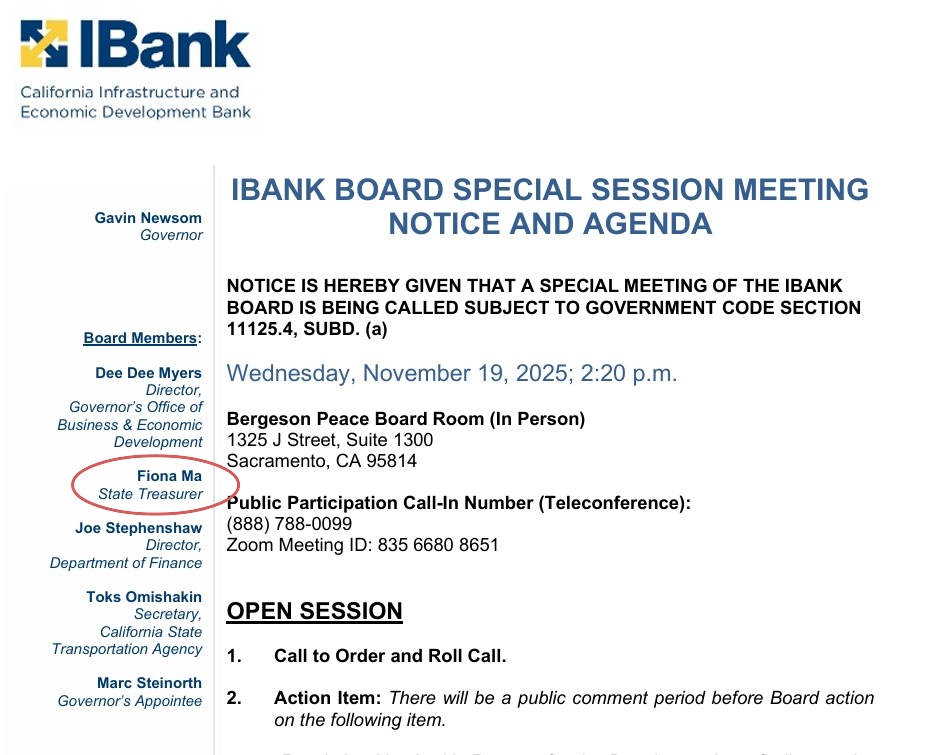
Ma listed as a board member of IBank on a meeting agenda.
But Swyft Cities suffered an unexpected setback in September. The City of Irvine drastically altered the timeline of their development plan for the Great Park. Documents from the April 22nd board meeting show that the firm was originally scheduled to have a pilot project for their proposed aerial gondolas ready at the end of 2026, and a full-blown system by 2028.
The city had now decided that aerial gondolas wouldn’t be needed until “Phase 3” of the plan, which is slated to go into effect in 2036–almost a decade away. That shift stripped away any sense of urgency for Swyft Cities to deliver a pilot project by December 2026; it also meant the firm could no longer justify seeking a government-backed loan guarantee from IBank.
Miranda Iglesias, a spokeswoman for BAAD, told The Investigator via email last Friday that though the firm had “shown interest in the Climate Tech Finance Program … they have not submitted an application.” She further added that “staff were unable to connect with Gondola Ventures and they are no longer an active priority to certify as a non-bank lender …”
And despite the fact the City of Anaheim partnered with Swyft Cities to explore the possibility of using aerial gondolas to connect entertainment venues, no commitment has been made. A source at city hall, who knew nothing about this investigation, expressed skepticism saying it’s a high‑exposure undertaking since the firm had never delivered an operational system.
Indeed, an email The Investigator obtained from the Orange County Transportation Authority, the countywide agency responsible for buses, freeways, and other major road projects, indicated that city planners in Anaheim were reluctant to proceed without someone else taking the initial risk. “They want to see it built in Irvine first to assess the system,” said one official.
Perhaps an unintended consequence of the Great Park’s decision to delay Swyft Cities system is that Ma will no longer be in a position to vote on any other government-backed loan guarantees they might seek. Besides the fact she is running for Lt. Governor, her term is up at the end of this year, which means she won’t be serving on the IBank board for that much longer.
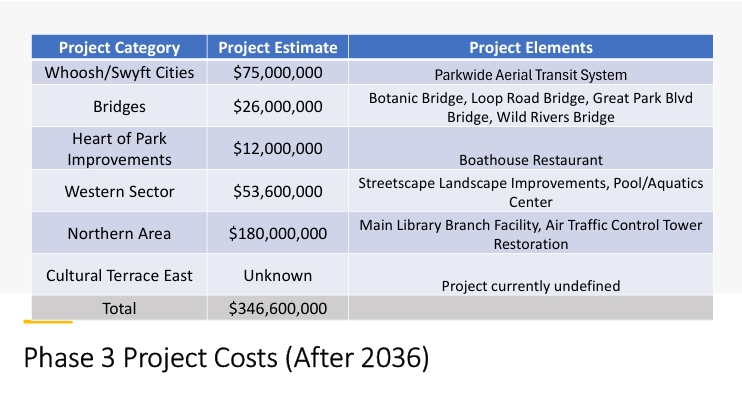
From a September 9, 2025 update released by the City of Irvine.
The Investigator made a good faith effort to reach out to Ma not only to seek her comments about the January 17th email, but her relationships with Vanderpool and Swyft Cities. But neither she, nor anybody at the state treasurer’s press office, who we copied our messages to, responded to any of our inquiries. Similar questions sent out to Vanderpool and Poskey went unanswered.
Regardless, the records show a pattern in which Ma’s personal network intersected with Swyft Cities’ efforts to secure government backing of their projects. These interactions were not disclosed publicly. Instead, they occurred very quietly, behind closed doors, raising concerns about whether the state treasurer inappropriately exercised her power on behalf of a private company.
The absence of the email Ma allegedly sent to Vanderpool is troubling. Its disappearance contradicts a message from the person it was copied to, suggesting either a failure to preserve official correspondence or a deliberate omission. Either scenario raises red flags about record keeping practices and whether politically sensitive information is being shielded from disclosure.
It should be emphasized The Investigator has evidence the state treasurer violated the law. In public records act requests we submitted, we asked for all communications exchanged between Ma and Vanderpool. Her office withheld numerous text messages from us–which is illegal. We ultimately secured many of them, but only through separate requests made to the City of Anaheim.
By steering attention toward IBank as a potential source of financing, Swyft Cities inadvertently cast a sharper light on Ma’s actions. As a board member, her discreet engagement with the firm invites questions about whose interests were being served. Public financing institutions require distance, yet her interactions hint at a level of closeness that challenges that expectation.
The Investigator will continue looking into this matter since questions it raises go far beyond any single company. Californians rely on elected statewide officeholders to uphold ethical standards that ensure decisions are made in the public interest. Whether Ma met that obligation remains unresolved, but the evidence uncovered so far warrants sustained scrutiny and public vigilance.








 anaheiminvestigator.com