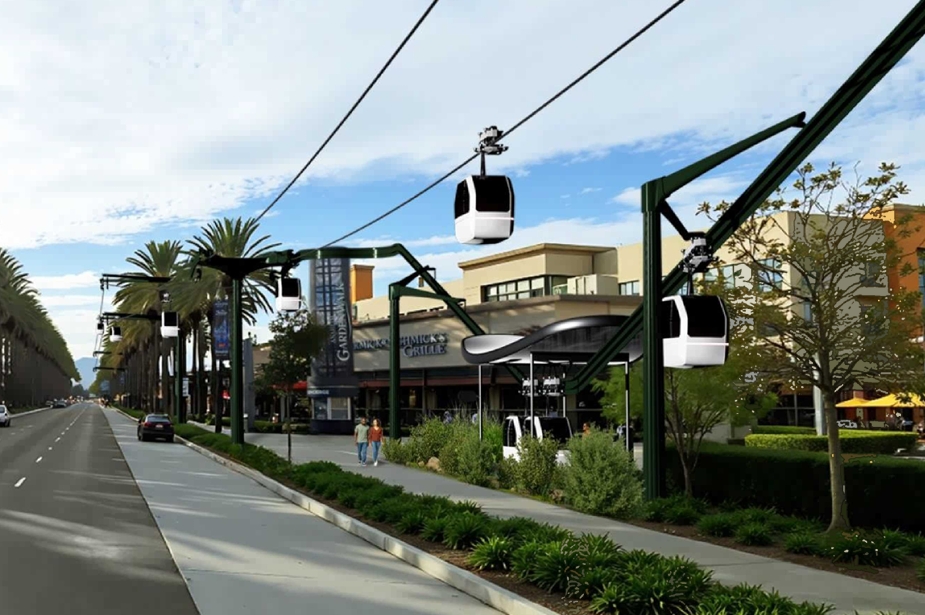
Concept image of what a gondola stop at Anaheim GardenWalk, located on the northside of Katella Avenue, might look like.
By DUANE J. ROBERTS Editor & Publisher
Internal emails, contracts, and PowerPoint presentations obtained by The Anaheim Investigator through the public records act reveal city planners are exploring the option of constructing an aerial gondola system to connect the Platinum Triangle with the Anaheim Resort in preparation for the 2028 Summer Olympics in Los Angeles.
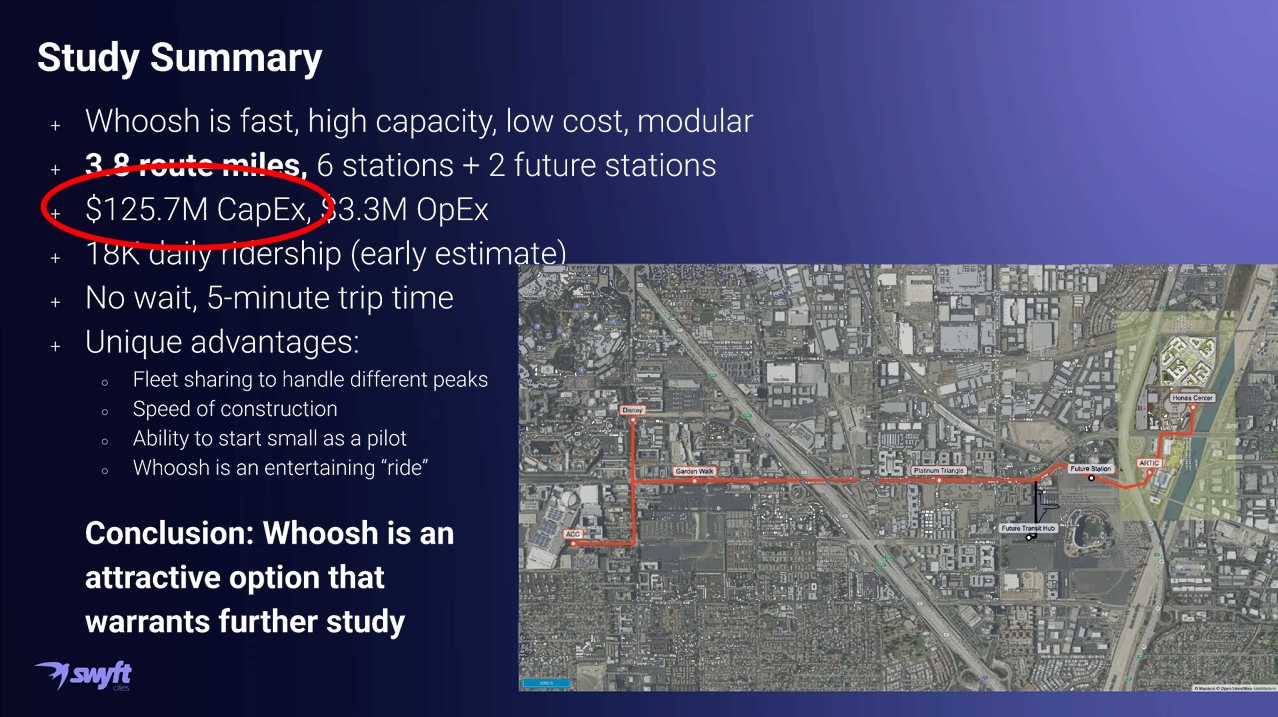
While the final route has yet to be decided, there seems to be interest in an alignment running east-west along Katella Avenue featuring six stops. At Harbor Boulevard, the line would split into two branches, each ending near the eastern entrances of Disneyland, California Adventure theme parks and the Anaheim Convention Center.
The Katella Avenue route for the proposed gondola system.
Emails reviewed by The Investigator show Jeral Poskey, CEO of Swyft Cities, and Clay Griggs, one of the firm’s co-founders, have already discussed their gondola concept with “key stakeholders” such as The Walt Disney Company and OCVibe, a $4-billion mixed-use district being developed on 100-acres of land surrounding the Honda Center.
In a March 5th message Griggssent out to several city planners working with him on this matter, he emphatically boasted that “our meeting earlier with OCVibe went very well,” hinting they were quite supportive of it. “They will be sending over plans for the parking garage; they are currently envisioning our maintenance facility on the top floor.”
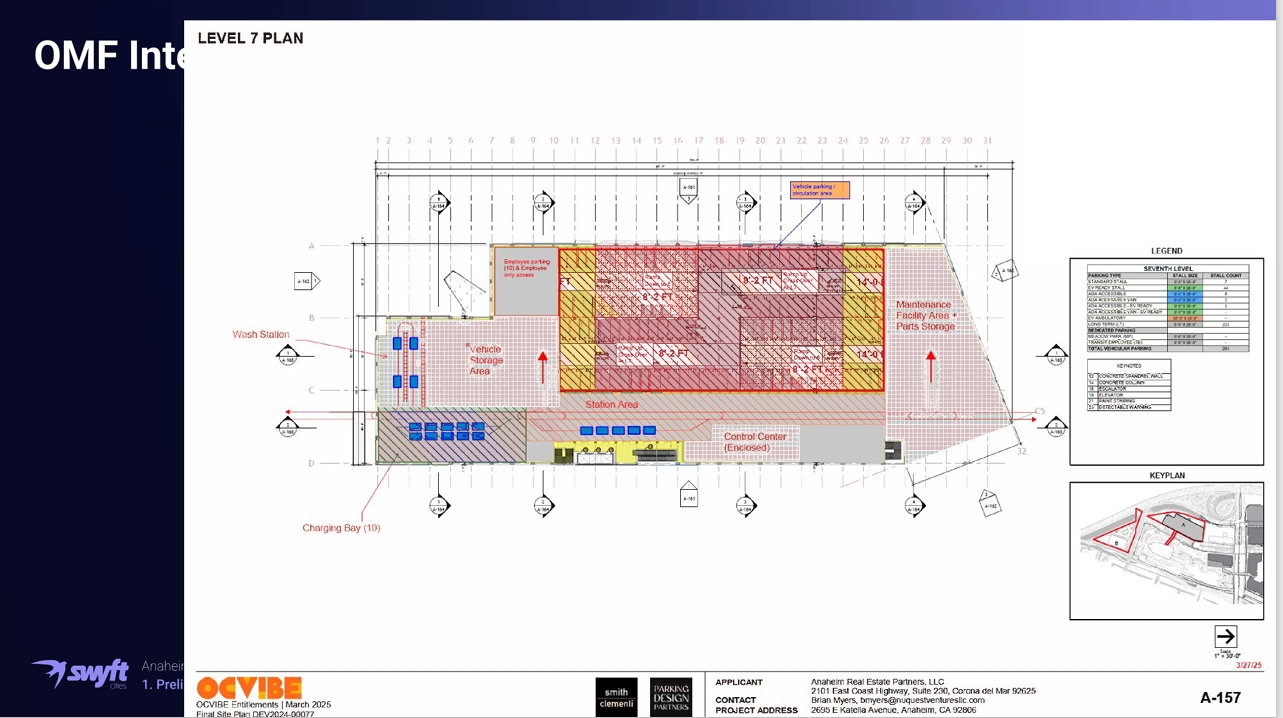
Indeed, a floor plan created by OCVibe and reproduced in a PowerPoint slide demonstrates their commitment to Swyft Cities isn’t just limited to offering space for a “maintenance facility,” but a control center, charging bays, and even a boarding station–all within walking distance of the Anaheim Regional Transportation Intermodal Center.
OCVibe floor plan for a gondola maintenance facility.
Concept image of gondolas next to OCVibe parking garage.
During initial talks with Swyft Cities, city planners were told that towers erected to hold the gondola cables in place could be specially customized to resemble the Los Angeles Angels’ iconic “Big A” logo—an idea which taps into Anaheim’s distinct character as being the only city in Orange County that hosts a major league baseball team.
Two design renderings the firm created not only contrast the scale and form of an imagined “Angels” tower with a “standard single” tower but also provide a birds-eye glimpse of how it might actually appear in real life facing west on Katella Avenue toward the Anaheim Convention Center and California Adventure theme park.
However, building a gondola system along Katella Avenue might be problematic. As Poskey himself acknowledged in an email, there are “palm trees”–literally hundreds of them. Many would have to be removed to make way for the towers, and it is not inconceivable that could generate opposition from both residents and hoteliers alike.
“Angels” tower vs. “Standard Single” tower.
Concept image for a gondola system using “Angels” towers.
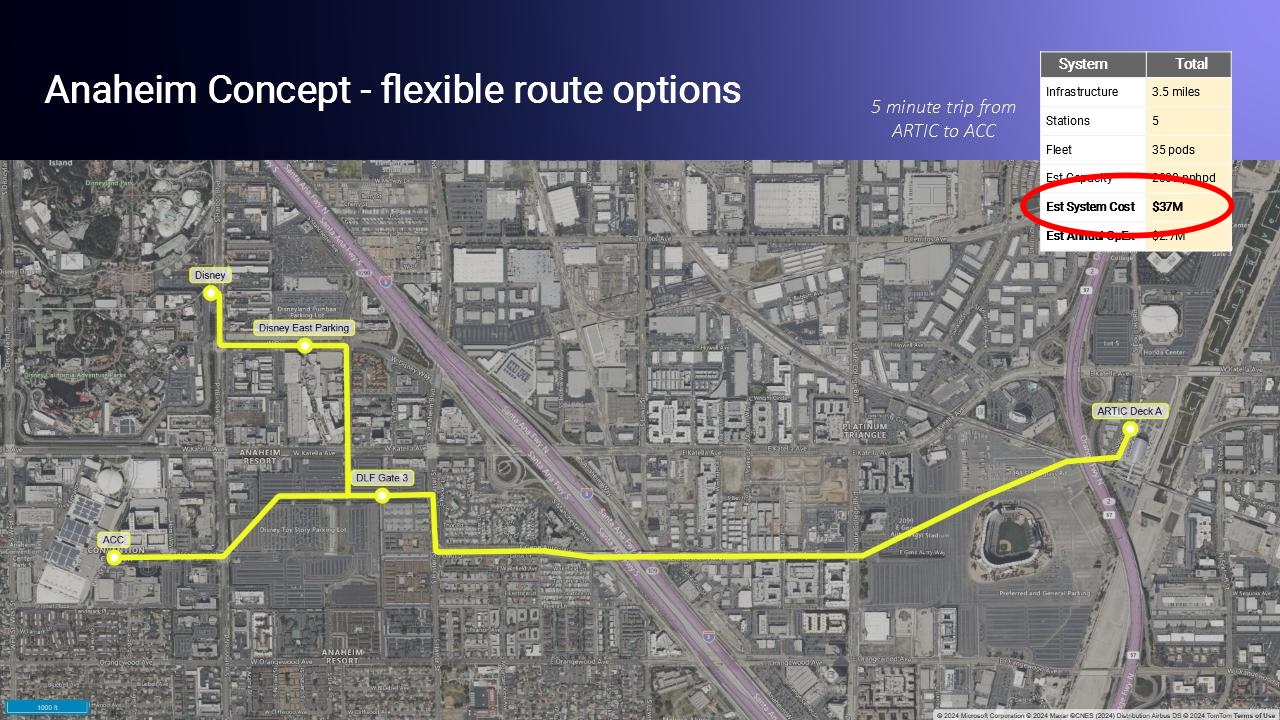
Last December, Swyft Citiesshared a PowerPoint presentation indicating that their gondola system—comprising of a fleet of around 35 “pods”—could be implemented at an estimated cost of roughly $33 to $37 million. This equated to just under $11 million per mile, subject to variation based on final design and alignment considerations.
Estimated cost for a 3.5-mile route last December: $37 million.
Estimated cost for a 3.8-mile route in July: $125.7 million.
As of today, no source of funds has been identified to pay for this system. However, one slide included in the July PowerPoint presentation says that financing could come from public-private partnerships, grants, and the California Infrastructure & Economic Development Bank, a public entity owned and operated by the state.
Emails reveal city planners here reached out to their Irvine counterparts to learn more about it. “I wanted to check in to see if you have cost estimates or any other useful information to share in your due diligence on Swyft Cities,” wrote Rudy Emami, public works director, in a March 11th message to Sean Crumby, who held a similar job in that town.
Email inquiry about the gondola project in Irvine.
While “key stakeholders” like OCVibe have quietly expressed enthusiasm for the gondola system, its implementation is not a foregone conclusion. Because Swyft Cities has never delivered a fully operational system, there are concerns about its ability to fulfill its promises–putting taxpayer money at risk of significant cost overruns and system failure.
Mike Lyster, the city’s chief communications officer, told The Investigator that gondolas aren’t the only option being explored to connect the Platinum Triangle and Anaheim Resort: “We continue to look at transportation technology from a half-dozen or more different providers. It would be incorrect to suggest we’re focused on a single one.”
“In the months ahead, we could issue a potential request for information from many different types of transit tech companies out there, including gondola, trackless, autonomous, trams and others,” Lyster added. “We may need a consultant to help with this process … But nothing has been decided, and nothing is scheduled at this point.”
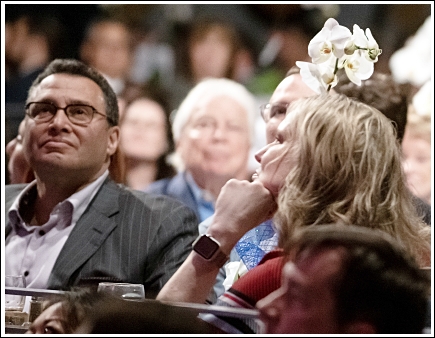
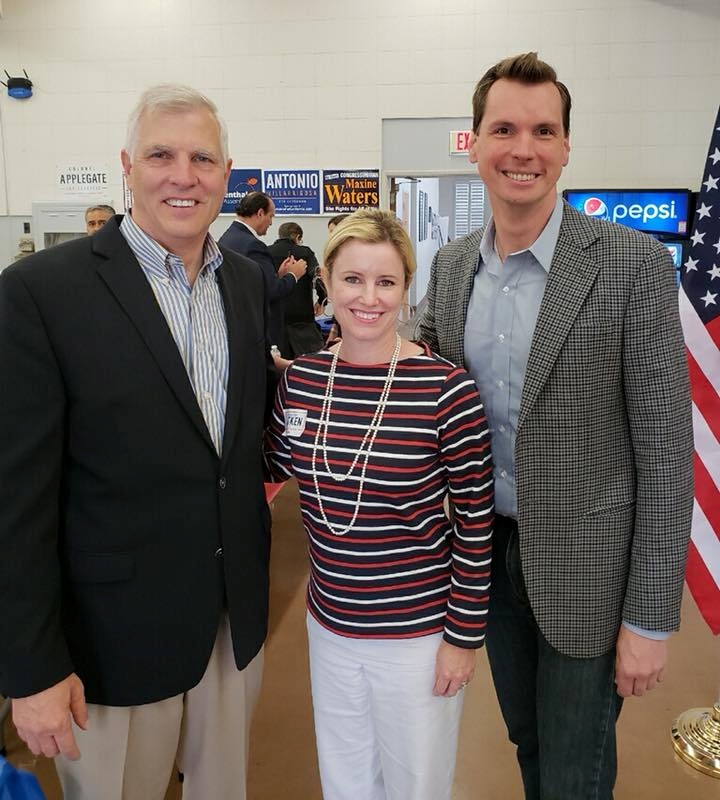
Ken Potrock (l), president of the Disneyland Resort, with Carrie Nocella (r) while Mayor Ashleigh Aitken’s father (c) sits at a table behind them.
By DUANE J. ROBERTS Editor & Publisher
On the evening of Thursday, June 22, 2023, The Anaheim Investigator emailed a routine public records act request asking Mike Lyster, Chief Communications Officer for the City of Anaheim, to release all photographs his office had that were taken “before, during, and after” Mayor Ashleigh Aitken’sState of the City address and luncheon, an event which took place at the City National Grove in May of that year.
In response, The Investigator got several dozen. Many were shot by Joshua Suddock, a freelance photographer, who had done work for the Orange County Register and other newspapers. Suddock, however, had a peculiar affinity: he loved taking photos of everything involving the Disneyland Resort. And several images that he captured of the audience listening to the mayor speak were quite revealing.
Suddock’s photos show Disney employees, many from their public relations department, came out in full force that day. In one of them, Ken Potrock, president of the Disneyland Resort, can be seen with Carrie Nocella, the controversial director of external affairs for the theme park. Seated in the background is Wylie Aitken, the mayor’s father, who, along with the rest of her family, was at a table right next to them.
Perhaps it was a fluke that both the Aitken family and representatives from The Walt Disney Companywere sitting so close to each other. But The Investigator has uncovered evidence suggesting ties between the two have previously been much deeper than what is publicly known. In fact, our reporting about their curious relationship with Nocellain December 2023 and last year was merely the tip of the iceberg.
Through a careful review of campaign finance paperwork filed with the state and federal governments, photos, archived website data, social media posts, and other records, The Investigator has learned the Democratic Foundation of Orange County, the political machine the Aitken family used for many years to exert their influence over local politics, was the recipient of thousands of dollars from The Walt Disney Company.
In addition, The Investigator has discovered that on at least one occasion, the Disneyland Resort gave the Democratic Foundation free meeting space for a fundraiser held at their Grand Californian Hotel, even providing food and drinks for its well-heeled members at absolutely no charge. And photos clearly show Michael Penn, the husband of Mayor Aitken, was with Nocella at this particular function.
The Democratic Foundation was founded in 1983 by Howard Adler, a developer, and Richard O’Neill, a rancher that owned 52,000 acres of land in south Orange County. Both men, who were active in the Democratic Party at the local and state levels, created it to be a counterweight to the Lincoln Club of Orange County, an elite group of businessmen who poured millions into the campaign coffers of Republican politicians.
The idea was to bring together at least 100 big donors who would each kick in about $1,000 a year to not only help finance voter registration drives, but to support Democratic candidates running for various offices. One of the group’s early successes was getting Tom Umberg elected to a seat in the state assembly in 1990. His main opponent was Curt Pringle, who would later become mayor of Anaheim in 2002.
After serving 17 years as chair, Wylie stepped down in 2009. However, he still maintained a tight grip on the organization through close allies like Dan Jacobson, the Tustin-based attorney who succeeded him, and Penn, his son-in-law. Archived website data shows that the elder Aitken ended up on their board of directors and was later joined by Penn, who became vice chair in 2016, and eventually chair in 2019.
Campaign finance records reviewed by The Investigator reveal the Democratic Foundation over the years received hundreds of thousands of dollars in cash from a tight-knit coterie of lawyers, corporate executives, elected officials, and party operatives. However, it also got money from another source: a billion-dollar entertainment giant whose amusement park in Anaheim claims to be “the happiest place on earth.”
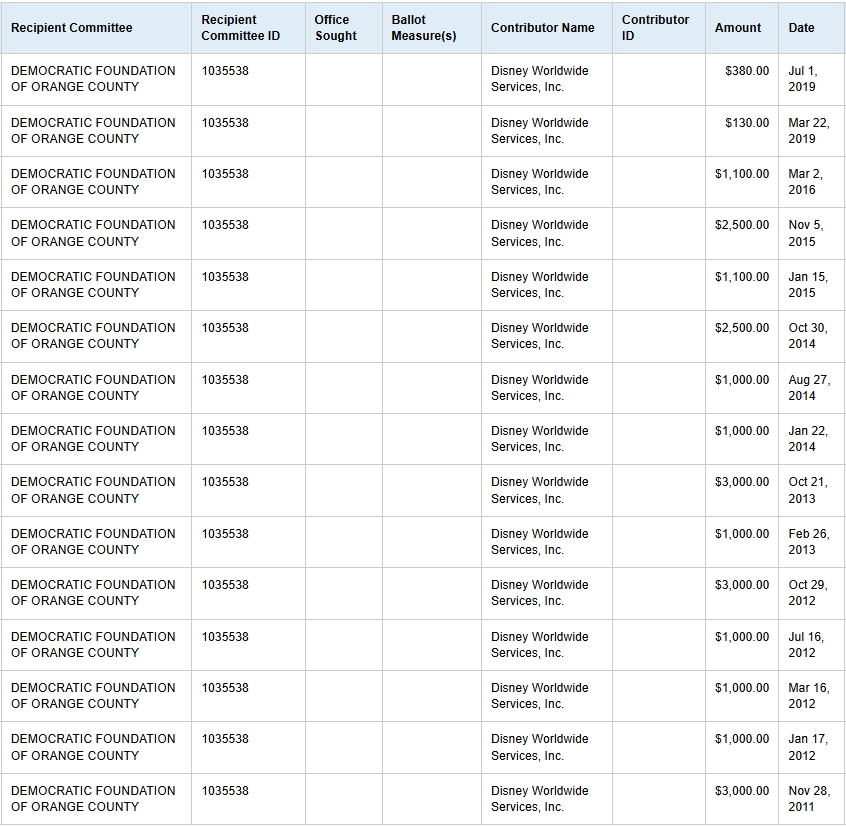
Between 2011 and 2019, The Walt Disney Company funneled about $22,710 into the Democratic Foundation. Though the yearly amounts varied, paperwork the latter filed with the California Secretary of Stateshows this corporate entity was a member of the group, even paying the required annual membership dues–something that Jacobson, the chair, would quite frankly admit in a message he posted on Facebook.
Data from the Secretary of State.
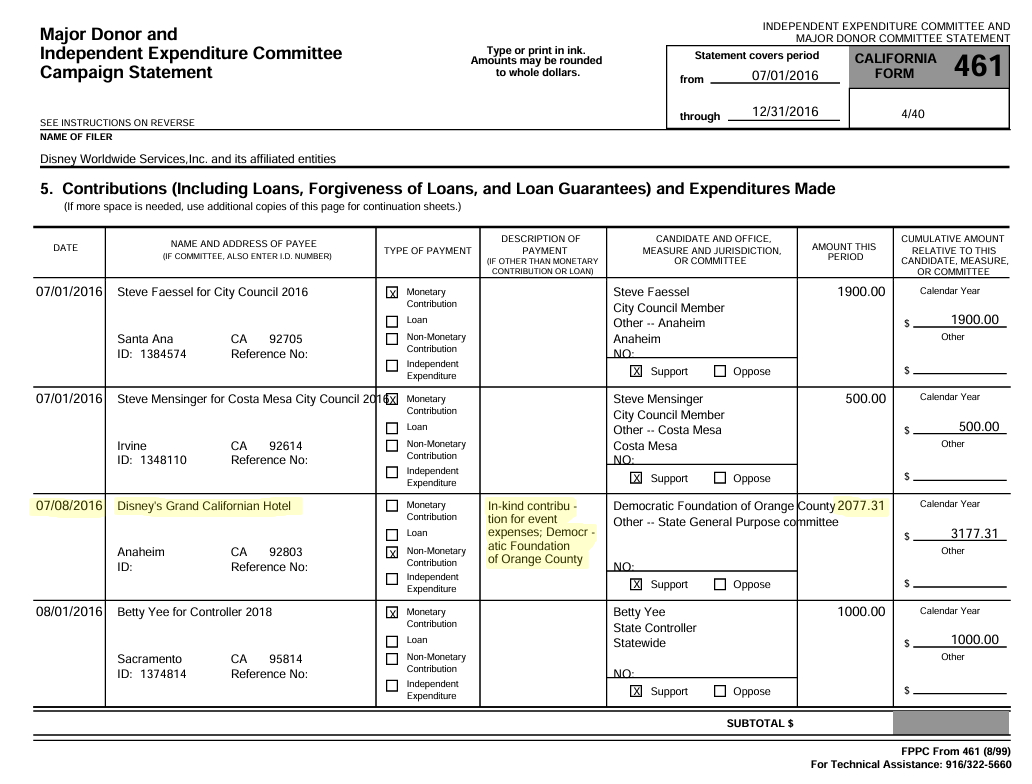
But the Democratic Foundation didn’t just get cash from TheWalt Disney Company. The Investigator has compelling evidence that on at least one occasion, the Disneyland Resort gave them free meeting space for a special fundraiser held at a restaurant located inside their Grand Californian Hotel, even providing food and drinks at no charge. And photos do show both Penn and Nocella were present.
The fundraiser in question, which took place on Friday, July 8, 2016, occurred in the private dining room of the Napa Rose. It was advertised by the Democratic Foundation, both on their website and social media, as being an “intimate meal” with State Assemblyman Anthony Rendon, a Democrat, who was then speaker. “This is not a banquet,” they emphasized. “We will all be seated at one table with Anthony.”
“The cost of the luncheon will be $1,100 per plate,” according to a message posted on their Facebook page in June 2016. “The money raised is slated to go toward the publication and distribution of the Orange County Voter Guide, our award-winning and beautiful mailer that goes to high-propensity Orange CountyDemocratic voters. So, your contribution will get Democrats elected in Orange County.”
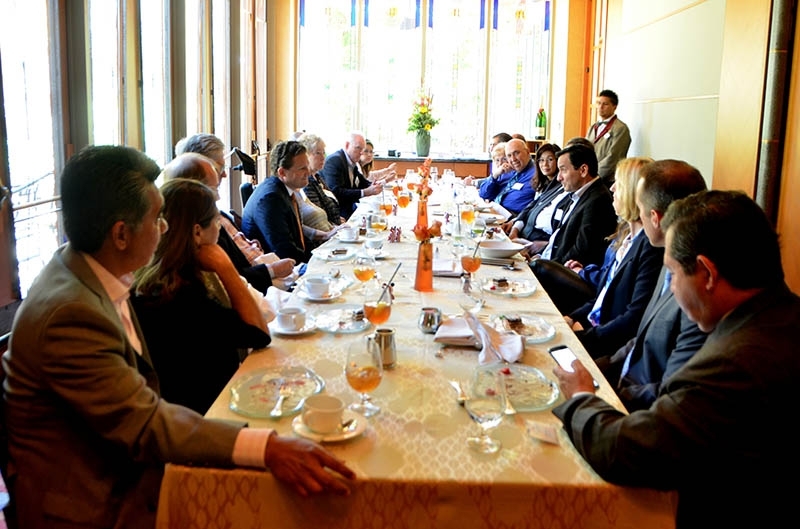
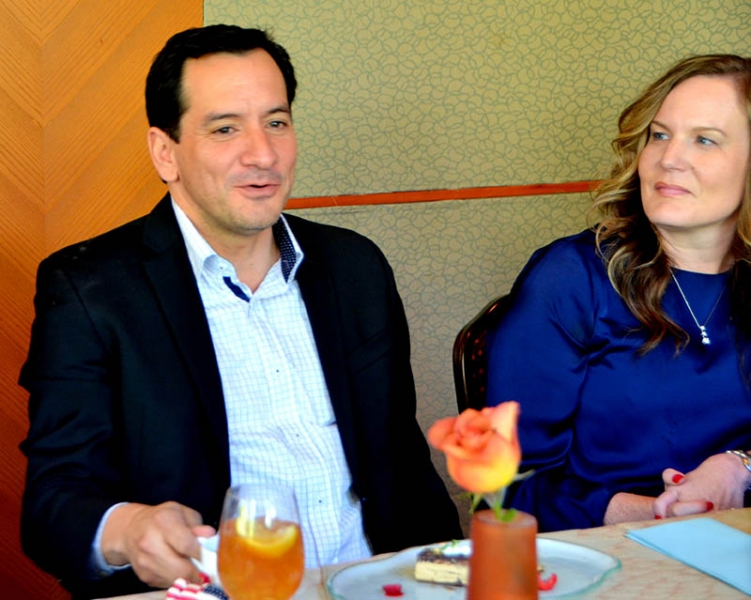
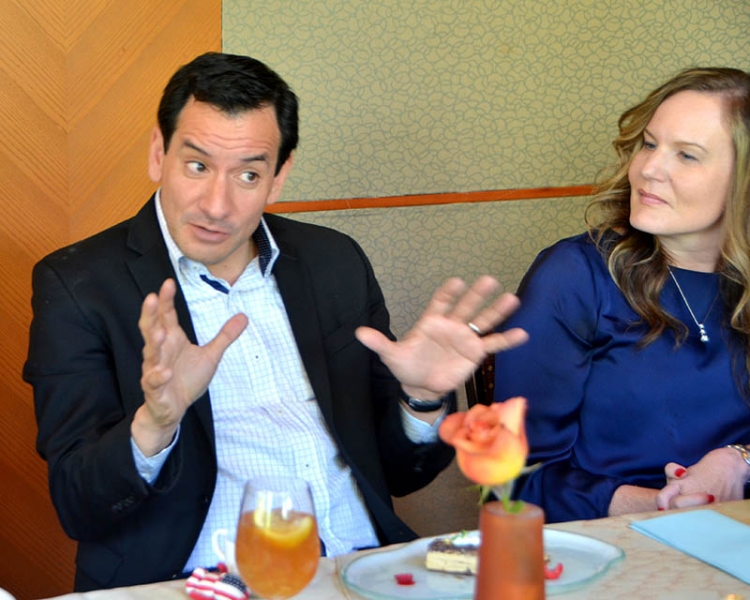
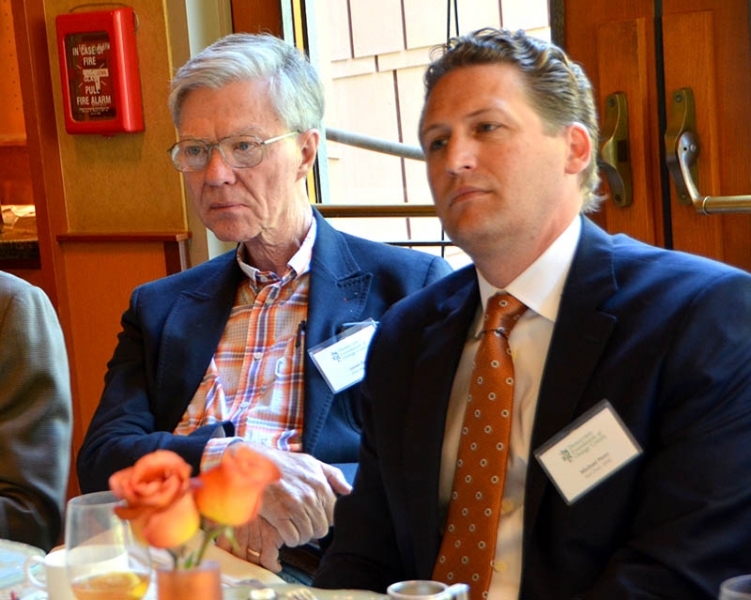
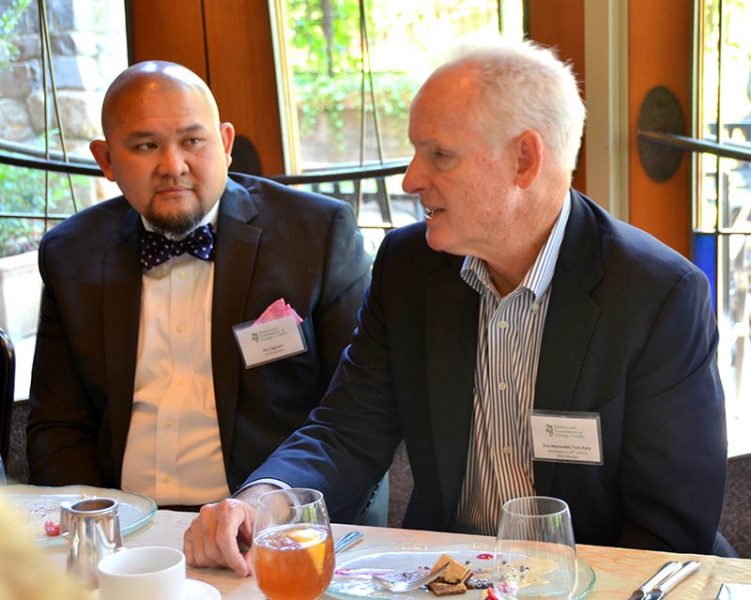
Numerous photos obtained by The Investigator reveal about 20 people were in attendance. The images show Rendon, who was the featured guest, had been seated in between Jacobson and Nocella. Directly across from him was Penn, who was vice chair. Further to his left was State Assemblyman Tom Daly; to his right, near the end of the table, was State Assemblywoman SharonQuirk-Silva and her husband.
Michael Penn seated across from Anthony Rendon at the Napa Rose.
Dan Jacobson with Rendon and Nocella.
Rendon and Nocella.
Rendon and Nocella.
Penn on the right.
Tom Daly on the right.
According to a Form 461 that The Walt Disney Company filed with the California Secretary of State in 2017, they reported spending $2077.13 on this fundraiser. Under the category which obligated the entertainment giant to at least partially describe what they paid for, it was listed as an “In-kind contribution for event expenses,” which means they footed the entire bill for meals, beverages, and other related costs.
This event was not the only one the Disneyland Resort hosted for the Democratic Foundation. In March 2012, they were allowed to use the Disneyland Hotel for a similar gathering with Congresswoman Loretta Sanchez. Food and drinks were free for members who paid their dues. But it was not a fundraiser. Beyond announcements posted online, no records of it could be found in any paperwork filed with the federal government.
It is not known if Nocella was present at this function. However, her links to the former congresswoman are well-documented. Last year, The Investigator pointed out that between January 1997 and August 1998, she was an intern for the Campaign to Re-Elect Congresswoman Loretta Sanchez, focusing on “campaign strategy, labor outreach and strategy, fundraising, and event planning.”
As The Investigator previously reported, this relationship goes back to the early 1990s. Between 1991 and 1993, Ashleigh and Nocella attended Rosary Academy, a small, elite Roman Catholic all-girls college-prep school located in Fullerton. Though they were not classmates, they shared similar politics and career goals: both women did campaign work for Congresswoman Sanchez; they later pursued law degrees.
More than a decade later, the career path Nocella embarked upon would once again intertwine with Ashleigh and her family. In 2010, after being made director of government relations for the Disneyland Resort, she became a visible figure within local political circles, mingling with elected officials who were linked to the Democratic Foundation–all of whom, interestingly enough, had deep ties to the Aitkens.
Nobody should be the least bit surprised with any of this. The Investigator has long since been aware politics is a game for the wealthy. Out of the 350,000 people who live in this town, only a tiny handful of rich people run it. And they mostly live in the same neighborhoods, send their children to same schools, belong to the same non-profit organizations, and sometimes even share the same circle of friends.
Ashleigh Aitken with Tom Umberg and Jordan Brandman in 2018.
For example, while investigating Nocella, we discovered Ashleigh’s political career was set into motion by Curt Pringle, who as Republican mayor of Anaheim, nominated her to the Community Services Boardin June 2004, and then again in June 2006. Despite the fact Pringle and her father had been at odds with each other in the past, the Aitkens allied with him to create the Muzeo Museum and Cultural Center.
The relationship between the two former adversaries grew so close that Wylie wrote out a $1500 check to the Curt Pringle for Mayor 2006 campaign committee on June 22, 2006, according to a Form 460 filed that year. Maybe it was just a coincidence, but public records show the contribution, the maximum allowed at that time, was made two days after the mayormoved to reappoint his daughter to a city board.
This article represents the last one of a three-part series by The Investigator which has explored the Aitken family’s ties to Nocella. During our two-year inquiry, we can now safely say it does in fact exist. But this relationship, like many others, appears to be transactional in nature and mostly a product of them being part of the same overlapping social and political networks that they share in common.
The reason why the Pringle connection was brought up was to show that the former Republican mayor, much like the Disney executive, belonged to similar networks the Aitkens circulated in. What apparently brought them together–besides Wylie’s possible desire to see his daughter be appointed to a city board to use as a stepping stone for higher public office–was the goal of creating the Muzeo Museum.
Like other ruling class families, the Aitkens have sat on the boards and committees of many different non-profit organizations–from the Girl Scouts of Orange Countyto Segerstrom Center for the Arts. This has allowed them to rub elbows with wealthy donors, corporate executives, and mega-billionaires who control the biggest business interests in Anaheim, such as Angels Baseball, Honda Center, and the Disneyland Resort.
The Democratic Foundation, the political machine they have controlled for years, has a long history of backing “business friendly” candidates for public office. That The Walt Disney Company gave them financial support should be of no surprise because this group has been pivotal in electing politicians who champion policies which make their theme park operations here in Anaheim extremely profitable.
Derek Smith, political director for United Food and Commercial Workers Local 324. a union whose headquarters are based in Buena Park.
By DUANE J. ROBERTS Editor & Publisher
An email currently in the possession of The Anaheim Investigator offers compelling evidence suggesting that Mayor Ashleigh Aitken might have deliberately misled journalists from a mainstream media outlet about the intended recipient of two city-owned tickets worth $350 to a Ducks vs. Bruins game which took place at the Honda Center on January 8th.
According to Biesiada and Elatar, records show Smith ran a committee “that spent over $138,000 promoting Aitken’s candidacy.” When asked why he got tickets, the mayor replied she “wanted to support a group that ‘represents Anaheim working families.'” But the reporters said they were “unable to confirm who actually used the tickets after she gave them to Smith.“
Form 802 filed by Aitken.
Though it’s not entirely clear as to what Biesiada and Elatar meant when they stated they were “unable to confirm who actually used the tickets,” The Investigator believes–and we admit this is speculative–that Aitken misled them by insisting she gave those tickets to the political director so that he could then pass them on to someone else at UFCW Local 324.
In an email dated January 5th with the subject header, “Ducks tickets for Sunday,” Lauren Torres, a city council services coordinator, received the following message from the mayor: “Hi Lauren,” wrote Aitken. “Can you please assign Sundays tickets suite to Derek Smith.” She included his email address and phone number, blacked out by the city clerk due to privacy laws.
Email proves tickets went to Smith.
The Ducks tickets that Aitken asked Torres to “assign” to Smith are not in paper form. They are only available electronically via smartphone through an app. The only way Smith could access them is through the email address he gave the mayor. Because tickets are “non-transferable,” nobody else could have used them unless Smith gave them control of his email account.
Perhaps it also should be mentioned that if Aitken did indeed inform these reporters the tickets she gave to Smith were originally meant for somebody else, that could open her up to criminal prosecution. For example, Penal Code 115 does make it a felony under state law to knowingly file a Form 802 with the city clerk that contains false and inaccurate information.
Last week, The Investigator sought further clarification regarding this matter and reached out to Biesiadaand Elatar to ask them about what Aitken specifically told them about the tickets she gave to Smith. So far, neither of them have responded to our inquiry. Aitken was also contacted by us to learn more. Unsurprisingly, the mayor completely ignored our email.
Ashleigh Aitken speaking at the headquarters of United Food and Commercial Workers Local 324 in November 2018.
By DUANE ROBERTS Editor & Publisher
In early January, Ashleigh Aitken, the newly-elected mayor of Anaheim, did what many public officials before her had done. She took full advantage of her unfettered access to the city’s vast pool of free tickets to luxury suites at the Honda Center and Angel Stadium and gave a few of them away to supporters who helped put her in office. Several emails show the mayor rattled off names of those she felt deserved them.
Besides the fact a Form 401 filed with the city clerk’s office reports that Smith was treasurer of an independent expenditure committee which spent $138,155 to help Aitken become mayor in 2022, The Anaheim Investigator has discovered his union has a “secret.” Though not criminal in nature, it’s deeply embarrassing. In fact, some people with intimate knowledge of it are apprehensive to talk about it openly with journalists.
It took The Investigator more than a year to find it, and that was only after painstaking research. However, all the effort put in was well worth it. We have uncovered a story that is not only remarkable, but lends credence to the old adage “politics makes strange bedfellows.” It involves an alliance of people with nothing in common, who were brought together by a shared interest. And it implicates Democrats and Republicans.
Todd Ament, Jeff Flint, and Harry Sidhu.
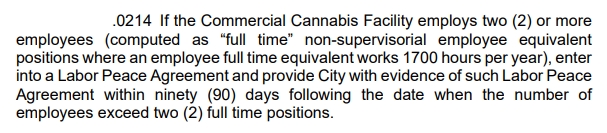
Reliable sources have told The Investigator that sometime in late 2019 or early 2020, Todd Ament, president and CEO of the Anaheim Chamber of Commerce, Jeff Flint, president of Core Strategic Group, and Mayor Harry Sidhu approached UFCW Local 324 and cut a deal: that in return for a labor peace agreement in any ordinance they introduced to legalize cannabis businesses, the union was to pressure the council to vote “yes.”
Ament, Flint, and Sidhu–sometimes euphemistically referred to as “the cabal”–already had three votes locked up, including Councilman Jordan Brandman’s, who reportedly was one of their point men. But they needed a total of four to get it passed. That’s where UFCW Local 324 came in. They would mobilize members of their union to aggressively lobby any possible holdouts. And indeed, there is evidence this did in fact occur.
Anaheim wasn’t the only city UFCW Local 324 was committed to getting a labor peace agreement. For example, minutes of one Stanton City Council meeting reveal: “Mr. Derek Smith, Political Director, UFCW 324, submitted an e-comment requesting that the City consider the inclusion of ‘Labor Peace’ language that would provide clarity to the cannabis industry and future workers regarding the quality of jobs that are expected from the City.”
For reasons that aren’t clear, Ament, Flint, and Sidhu abandoned the idea of getting a cannabis ordinance passed by council. The November 2020 election led to Avelino Valencia III and Jose Diaz winning seats. Though backed by Anaheim Chamber of Commerce, they weren’t trusted. And Gloria Ma’ae–who opposed the original ordinance–later replaced Brandman. But in late 2021, a new strategy emerged, thanks to UFCW Local 324.
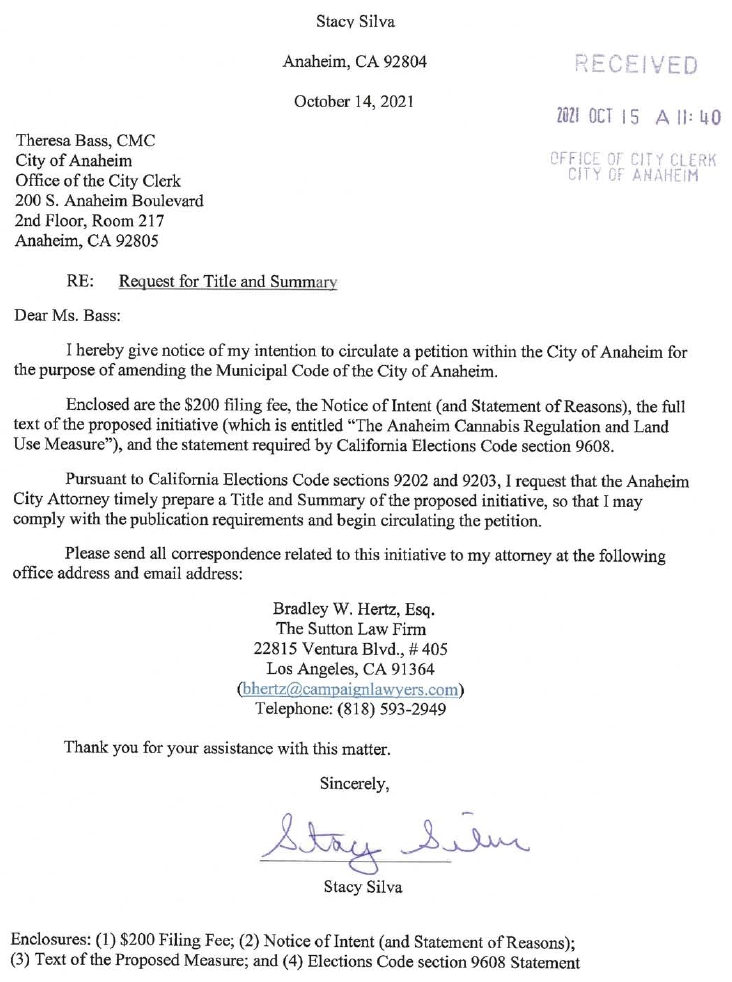
The Silva petition.
On Friday, October 15, 2021, the Anaheim City Clerk received a letter from Stacy Silva declaring that it was her “intention to circulate a petition” to gather signatures to put an initiative on the ballot entitled “The Anaheim Cannabis Regulation and Land Use Measure.” She filed all the required paperwork and paid a $200 filing fee. Silva instructed the city clerk that all correspondence be sent to her lawyer at his Woodland Hills office.
Silva’s lawyer was Bradley Hertz, an election law attorney who had done work for Ament. A Form 410 filed with the city clerk’s office on September 26, 2018 reveals he was treasurer of an independent expenditure committee called “No on L, a Project of the Anaheim Chamber of Commerce,” which spent $932,053 in an unsuccessful attempt to defeat a measure which raised the wages of workers of hotels that received tax subsidies.
The text of the initiative Silva submitted was mostly a copy of the cannabis ordinance championed by Ament, Flint, and Sidhu in 2020. However, there were exceptions. First, the number of permitted cannabis retailers allowed to operate in the city was increased from from 20 to 30; one single entity could control up to five of them, instead of three. Second, the requirement workers be full-time to qualify for a labor peace agreement was scrapped.
Herein lies the “smoking gun” of UFCW Local 324’s alliance with the Anaheim Chamber of Commerce to legalize cannabis businesses. They first tried to pass an ordinance through the council, but failed. Now there was evidence they were collaborating on a ballot initiative. However, there is a catch. Ament had resigned before Silva filed her paperwork with the city clerk. That begs the question: who took his place?
Regardless of what the case might be, Silva withdrew her initiative on October 28th claiming it needed “minor edits.” Then she submitted a new version on November 22nd, which reinstated the requirement workers be full-time to qualify for a labor peace agreement. But after December 7th, everything stopped. When The Investigator asked City Clerk Theresa Bass what happened, she said Silva didn’t continue the filing process.
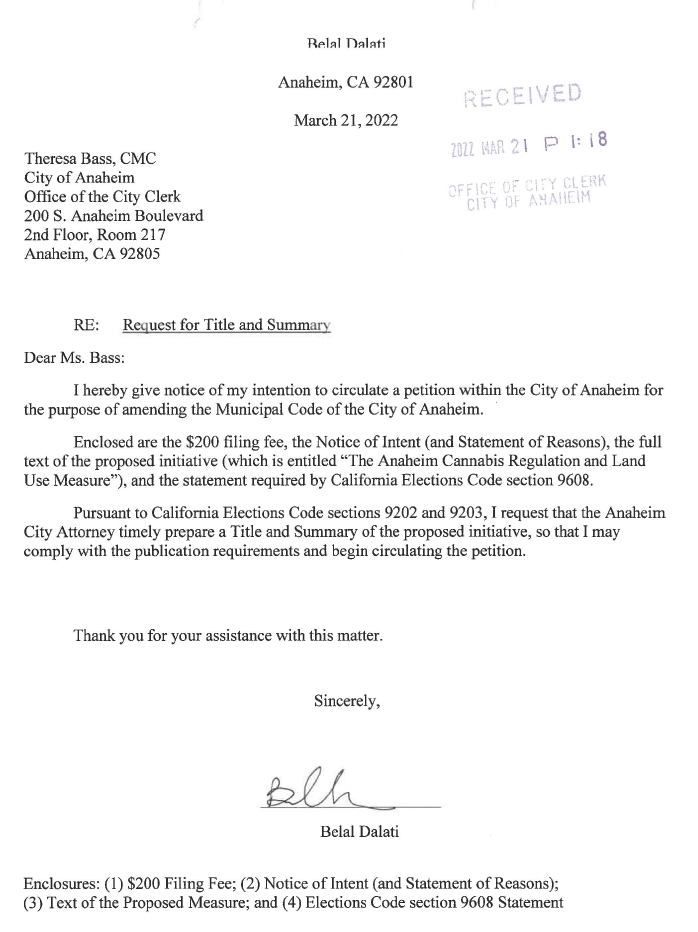
The Dalati petition.
Three months later, a new face appeared. Belal Dalati, a local real estate agent, walked into the city clerk’s office on Monday, March 21, 2022 with a letter notifying them it was his “intention to circulate a petition” to gather signatures to put a cannabis initiative on the ballot. Most of the paperwork he filed was identical to Silva’s. He used the same title, preamble, and law firm as a contact. But the text of the initiative was different.
Unlike Silva’s initiatives, Dalati’s came from Adam Spiker, of Spiker Rendon Consulting, Inc., a cannabis industry lobbyist located in downtown Los Angeles. The initiative he touted was very “pro-labor.” Not only did it drop the requirement workers be full-time to qualify for a labor peace agreement, but a points system was set up to give preferences to applicants of city licenses who had good employee and community benefits plans.
By May 16th, Dalati changed his mind. At the urging of Bill Taormina and Paul Kott, two local businessman who were opposed to legalizing cannabis businesses, he withdrew his initiative. In a text message Taormina sent to Councilman Trevor O’Neil, he alleged that “Bill Dahlati [sic] was forced into filing the petition by Jeff Flint and other ‘dope dealer’ promoters. He was actually threatened by them not to withdraw the petition ….”
In the days and weeks that followed, the public would learn–thanks to FBI affidavits released in court filings–this scandal wasn’t just about Sidhu and the stadium deal. At the very heart of it was Melahat Rafiei, a political consultant and Democratic Party operative, who is alleged to have committed various crimes in connection with the Anaheim Chamber Of Commerce’s attempt to legalize cannabis businesses.
However, in writing this article, The Investigator made a decision to mostly stay away from Rafiei. Why did we do this? First, her name didn’t pop up in anything having to do this story. Second, the FBI affidavits that have been released so far offer an incomplete and distorted view of what transpired. Third, the testimony offered in those affidavits are solely focused on proving violations of federal criminal laws. It doesn’t talk about what was legal.
Besides Rafiei, it’s erroneous to presume that everybody who worked along with Ament, Flint, and Sidhu to legalize cannabis businesses broke the law. Nothing can be further from the truth. The reality is, an overwhelming majority of people that ended up being dragged into this affair–including pretty much everybody we mentioned in this article–are innocent of any crimes. They are what we would call “victims of circumstance.”
The Investigatorknows despite our good faith efforts to gather accurate information for this article, what we have written isn’t the full story. And it’s possible a few corrections will need to be made as we learn more. But what’s important is we have exposed the biggest “secret” of this scandal: UFCW Local 324‘s alliance with the Anaheim Chamber of Commerce to legalize cannabis businesses. And it implicates Democrats and Republicans.
The political ramifications of this “secret” are political dynamite. For example, during last year’s election, in order to win the endorsement of the Orange County Register, then-candidate Aitken told the editors “the former mayor and his tightly knit ‘cabal’ were allowed to run roughshod at City Hall, and created a culture of intimidation for staff, management, concerned residents, and the smaller business community.”
What Aitken neglected to mention is UFCW Local 324, a major union of whom she has had close ties to since 2018, was involved in a “pot deal” with the same “former mayor and his tightly knit ‘cabal.'” Though there is no evidence of any criminal wrongdoing, it does vastly complicate things. Maybe she didn’t know about it, but giving $350 worth of city-owned tickets to Smith, their political director, won’t help her in any pleas of innocence.
For matter of record, The Investigator asked for interviews or sent questions outto Belal Dalati, Harry Sidhu, Derek Smith, Stacy Silva, Adam Spiker and others we believed had knowledge about this matter. Most didn’t answer our emails or reply to voice messages. One person declined to speak citing ongoing “local and federal investigations.” Ashleigh Aitken ignored our request for comment on the Anaheim Ducks tickets she gave to Smith.
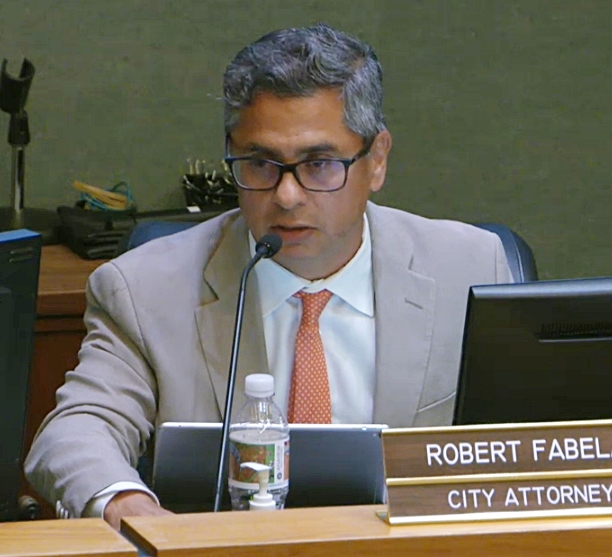
Robert Fabela, City Attorney for the City of Anaheim, speaking at a meeting of the Anaheim City Council earlier this year.
By DUANE ROBERTS Editor & Publisher
In a highly unusual chain of emails obtained from the City of Anaheim last year through the public records act, City Attorney Robert Fabela appears to have advised Councilman Avelino Valencia III to “lie” to The Anaheim Investigator about the underlying reasons why he handed out several thousand dollars worth of city-owned Angels baseball tickets to his campaign backers–something of which the city attorney has emphatically denied.
The emails in question, which were also shared with City Clerk Theresa Bass and Chief Communications OfficerMike Lyster, offers a rare glimpse into a system that holds nobody accountable for misusing any of the hundreds of tickets the city gets each year from Angel Stadium and Honda Center, allowing politicians like Valencia to give them away like candy to big donors, personal friends, and union leaders who helped get him elected.
In an attempt to learn more about the “good work” these people did, The Investigator sent Valencia an email on June 17th which listed the names of 22 individuals that public records showed were the recipients of his ticket largess between the months of April and May. “In the interest of full public disclosure, [we’re] requesting information as to the type of ‘volunteer public service’ each of the above persons are engaged in,” we wrote.
It wasn’t until in mid-July The Investigator learned Valencia was concerned about our inquiry into the reasons why he gave out tickets. A chain of emails obtained through the public records act showed that shortly after receiving our June 17th message, the councilman forwarded it to Fabela and Bass, asking them for help. “Please see the below email I received,” he said. “I would appreciate your advise [sic] and direction regarding the request.”
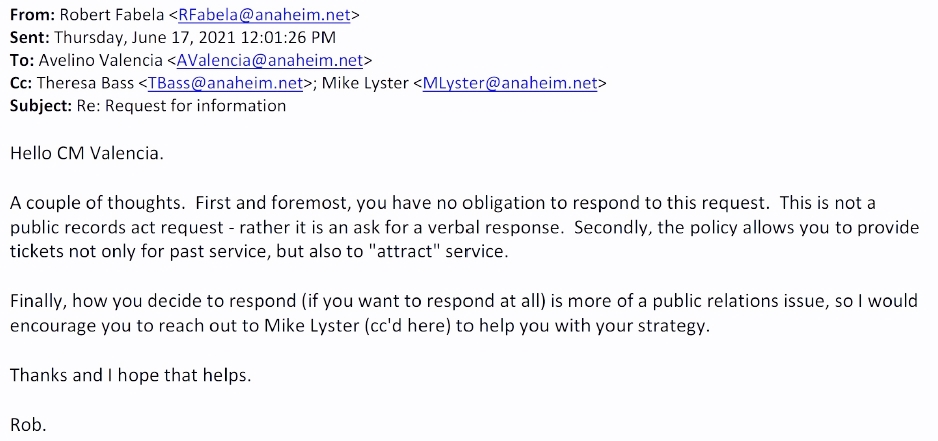
Within a half hour, Fabela issued a reply. The city attorney told Valencia he had “no obligation to respond” to The Investigator because it was “an ask for a verbal response.” Furthermore, he stated “policy” allows the councilman to “provide tickets not only for past service, but also to ‘attract’ service.” And finally, Fabela said if he does choose to respond, that this is “more of a public relations issue,” urging him to contact Lyster “to help him with … strategy.”
Forty minutes later, Bass followed up with an email backing one of Fabela’s points. “For reference, I am attaching a copy of our Ticket Policy — Section 5.0 states the conditions by which tickets may be distributed,” the city clerk told Valencia. “As noted by Rob, the policy allows for ‘attracting or rewarding volunteer public service’ which was noted on your Form 802, meeting the requirements of the policy and FPPC Form 802.”
Fabela’s email to Valencia.
The chain of emails The Investigator discovered–especially the one sent out by Fabela–offers us a behind-the-scenes look into why the ticket system has been constantly plagued with cronyism and corruption. Though part of problem lies with bad policies that have allowed council members to hijack it for political purposes, evidence we have unearthed seems to hint an overly compliant city bureaucracy might also be enabling this unethical behavior.
That Valencia sought advice from Fabela on how to respond to The Investigator’s email is in itself amusing. After all, the councilman had already gone on record at the June 8th meeting as saying he just gave tickets to “public members who were doing good work for the community.” Since all we requested was that he provide us with information as to the type of “good work” they did, why was there a need to consult the city attorney?
But it is what Fabela instructed him to do that is of great significance. Besides the fact he told Valencia that he could ignore The Investigator–and thus stonewall our inquiry–it appears he advised him to “lie” about the reason why he handed out those tickets, reminding the councilman that “policy” also allows him to “provide tickets … to ‘attract’ service”–a flimsy pretext which doesn’t require recipients to do any “volunteer public service.”
To better understand the context of Fabela’s advice, it was given after the councilmanhad already handed out tickets to 22 individuals–most of them campaign backers–between the months of April and May. And by reminding Valencia that “policy” also allows him to “provide tickets … to ‘attract’ service,” the city attorney hinted a different pretext could be used to justify what he did, thus “lie” about his reasons for distributing them.
What is most revealing about Fabela’s email is he never advised Valencia to truthfully answer The Investigator’s questions. Given that taxpayers own these tickets, one would think the city attorney would zealously guard their interests. Not so. Everything he wrote, whether intentional or not, encouraged the councilman to be deceptive. Even his suggestion Lyster be contacted to formulate a response hinted it be a spun narrative.
The emailthat Bass sent out, however, was more straightforward. The city clerk was correct when she told Valencia “policy allows for ‘attracting or rewarding volunteer public service’ which was noted on your Form 802, meeting the requirements of the policy and FPPC Form 802.” There is nothing on ticket disclosure forms which require council members to explain why they gave them away. But they do have to identify a “public purpose.”
A Form 802 that Valencia filed in April 2021.
It is not a strange coincidence that on every Form 802Valencia filed for each big donor, personal friend, and union leader that he gave city-owned Angels baseball tickets to, he listed “attracting or rewarding volunteer public service” as the “public purpose.” That’s because this “public purpose,” as it is currently written, contains a major loophole which enables council members to hand out tickets to anybody on a flimsy pretext.
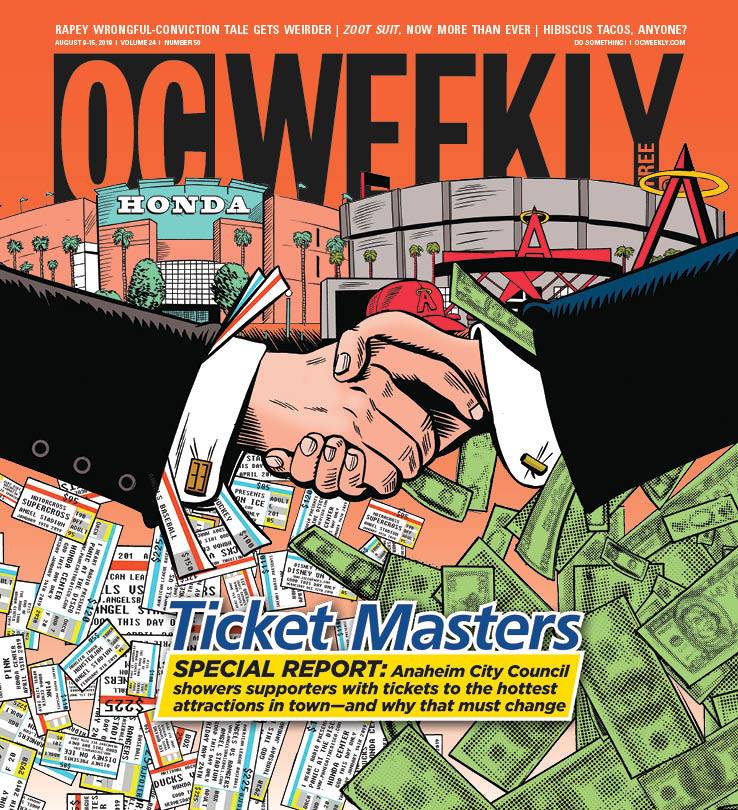
This loophole was first noticed by Gabriel San Roman, a former investigative journalist for the defunct-OC Weekly. While reviewing more than 1,539 ticket disclosure forms in 2019, he discovered a common pattern among council members who were abusing the system for their own selfish motives: they noted on each Form 802 they filed that they gave away tickets for the “public purpose” of “attracting or rewarding volunteer public service.”
Upon further scrutiny, San Roman learned this “public purpose” allowed council members to disburse tickets for two entirely different reasons: they can give them to “reward” people for “volunteer public service” they have done; or give them to “attract” people to do “volunteer public service” in the future. Since council members aren’t obligated to explain why they gave them away, nobody ever knows which of these two they chose.
The ambiguous nature of this “public purpose” has created a loophole which council members have been all too eager to exploit: if tickets can be given away to “attract” people to do “volunteer public service” in the future, then the recipient doesn’t have to do anything to earn them. Over the years, this flimsy pretext has paved the way for doling them out to practically anybody–big donors, lobbyists, political operatives–you name it.
OC Weekly cover story on August 9, 2019.
For matter of record, The Investigator did reach out to Fabela seeking his comment for this article. We asked the city attorney point blank if in the advice he gave to Valencia that he was “encouraging him to be deceptive—if not ‘lie’ to us—should he have chosen to respond” to our inquiry requesting he provide “additional information about his reasons for handing out tickets to 22 people during the months of April and May 2021”
“The answer to your question is ‘no’ as your inquiry is based on a misreading of both the email and the City ticket policy,” said Fabela. “The question to the Council member incorrectly assumed that past public service is the only criteria allowed under the City’s ticket policy, and my email to the Council member corrects that and reflects what City policy actually states. I do not see how that could be interpreted as encouraging anyone to ‘lie.'”
Regardless of what the city attorney’s intent was, it’s quite evident that Valencia felt empowered by what he said to continue distributing tickets to campaign backers without fear of any repercussions. Though the councilman has been handing more of them out to local residents and non-profit groups, he still doles tickets to cronies who not only have helped get him elected to public office in the past, but will probably do so in the future.
Below is the chain of emails set into motion by The Investigator’s inquiry into the recipients of Councilman Avelino Valencia’s tickets on June 17, 2021.
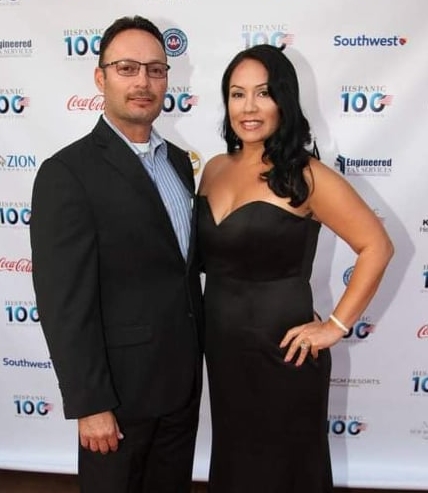
Gerry Serrano (left), President of the Santa Ana Police Officers Association, with Serina (right), his wife, at an event in Newport Beach in 2017.
By DUANE ROBERTS Editor & Publisher
In 2019, when Gabriel San Roman, a former investigative journalist for the defunct-OC Weekly, reviewed more than 1,539 ticket disclosure forms—Form 802sas they are called—to see who received the thousands of dollars worth of tickets the city got each year from Angel Stadium and Honda Center, he noticed an unusual practice: some council members were trying to avoid publicly disclosing the identity of persons they were really giving tickets to by reporting that they gave them to their spouse instead.
For example, San Roman discovered that then-Councilman Jordan Brandmanhad given city-owned tickets valued at $900 to Carrie Nocella, a lobbyist for The Walt Disney Company. But on the Form 802 that was filed, he stated those tickets were meant for Tom Nocella, her husband. Brandman had a ready-made excuse. “Tom is a longtime Anaheim resident,” he said. “Like all other council members, I regularly recognize numerous residents, community groups and city employees by behesting them tickets …”
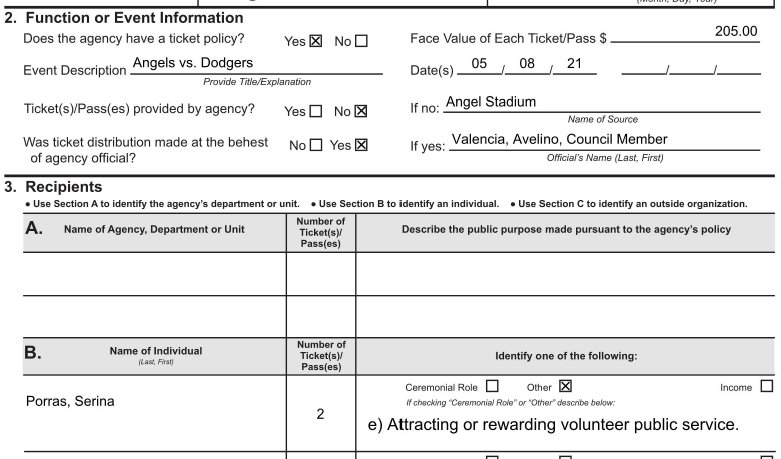
But documents The Investigator obtained under the California Public Records Act show Valencia may have tried to go further than this. An earlier Form 802 the councilman submitted offers prima facie evidence suggesting he made an attempt to hide Serina’s identity from public disclosure by using Serina Porras, her maiden name, instead of Serina Serrano, her married (and legal) one. If this form had been officially filed with the city under her maiden name, it would have been much harder to link her to Gerry.
Screenshot of the withdrawn Form 802 with Serina’s maiden name.
In a followup message, Torres told Serina that he got this information directly from the councilman. “I was unaware that we had your old name filed,” he typed. But in a stunning admission, he acknowledged to Serina he knew what her legal name was: “Frankly, I used Serina Serrano for this email thread because that was your apparent name based on your email address.” Indeed, The Investigator has an unredacted copy of her personal email address and can confirm he was using it to communicate with her.
Though Torres would later claim Valencia was “unaware of the name change,” all of this begs the question of how he knew Serina’s maiden name was Porras? Furthermore, the councilman himself most likely provided his city council assistant with her personal email address. Wouldn’t it be reasonable to assume since that email has Serrano as her last name, that’s how she identifies herself? Perhaps it should be noted she uses it as a last name on all of her identifiable social media accounts as well.
Under California state law, there are criminal statutes—specifically Penal Code 115—which make it a crime to file a false Form 802 with a government agency. For example, if a person knowingly files a document that contains inaccurate information, they could face a felony charge. However, a document has to have been officially filed with an agency before a prosecution can take place. That didn’t happen in this situation. The Form 802 in question was withdrawn and quickly replaced with a corrected version.
Regardless of what Valencia was trying to do, he definitely had a motive to conceal his ties to Gerry Serrano. Not only has the latter been a controversial and divisive figure in Santa Ana politics, but he has been subject of multiple investigations into alleged misconduct by local, state, and federal authorities–including reportedly being the target of a grand jury probe. The councilman’s squeaky-clean image would undoubtedly be tarnished if he was caught handing out tickets to such a troubled individual.
For matter of record, The Investigator emailed Valencia approximately three times requesting comment for this article. We wanted to know the reason why he felt motivated to use Serina’s maiden name on the original Form 802 he submitted, then later withdrew due to her questioning why it was being used. We were hoping that his reply would put our concerns about this matter to rest. But so far, the dapper councilman from District 4 hasn’t bothered responding to any of the messages we sent him.
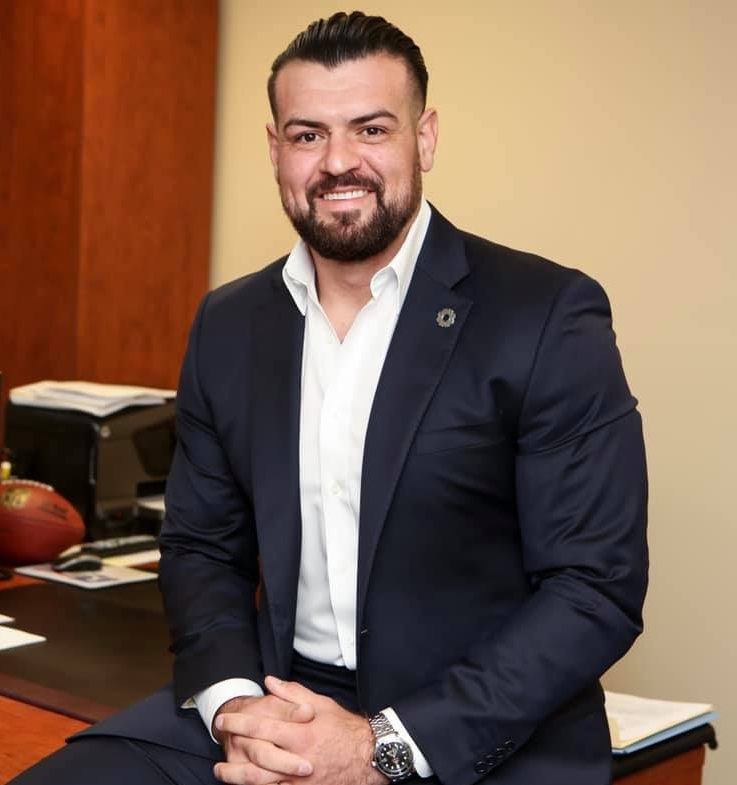
Councilman Avelino Valencia III gave $3,280 worth of city-owned Angels tickets to close friends, campaign backers, and top Democrats in April.
By DUANE ROBERTS Editor & Publisher
Before Councilman Avelino Valencia III was elected to his seat, he told a reporter from Anaheim Exclusivo what his main priority would be. “I would like the residents of Anaheim to know that I am dedicating the next four years of my life to improving the quality of life for our residents,” he said. “I will be selfless in those endeavors; I will put the residents’ needs first.”
But there is an old adage about politicians: watch what they do, not what they say. And evidence is mounting that there is a big difference between Valencia’s behavior as a councilman and his rhetoric as a candidate. Thanks to Gabriel San Roman, a former investigative journalist for the defunct-OC Weekly, we know as a fact that this happens to be the case.
In an article San Roman recently posted on his Slingshot blog, he observed that with the reopening of Angel Stadium and Honda Center due to relaxed COVID-19 restrictions, a once “dormant political patronage system” has sprung back to life “with Anaheim city council members able to dole out free tickets to their well-connected friends and political backers again.”
In reviewing the latest filings for April, he discovered not much had changed. For example, Councilman Jordan Brandman, who is a notorious peddler of city-owned tickets to lobbyists, campaign contributors, and even his former employer, gave two Angels tickets worth $410 to a businessman who appears to have been one of his clients at a previous job.
Even Valencia has gotten tickets.
The most astonishing revelations, however, came from Valencia’s filings. Being a newcomer, one thinks he would have been a bit more circumspect in his actions. But San Roman reported that his Form 802s showed the councilman freely gave away tickets to close friends, trade union leaders who helped finance his campaign, and known Democratic Party operatives.
In response, The Anaheim Investigator launched its own investigation into this matter and carefully scrutinized all of the Form 802s Valencia filed in the month of April. The documents not only corroborate the initial claims San Roman made in his piece, but new information has been uncovered which reveals that what he reported was just the tip of the iceberg.
The Form 802s show Valencia gave tickets to ten people, eight of which could be positively identified. Of those eight, all are “well-connected friends and political backers” of the councilman. Five have close ties to unions that each made a $2,100 contribution to his city council campaign last year. Two are top Democratic Party operatives. And most don’t live in Anaheim.
Below is a list of persons of who benefited from his largess: ERNESTO MEDRANO
Form 460sfiled by the “Valencia for City Council 2020” committee report that the Laborers International Union of North America Laborers Local 652 (ID# 72-151970)made a $2,100 contribution on June 29, 2020.
Form 460sfiled by the “Valencia for City Council 2020” committee report that the Santa Ana Police Officers Association Independent Expenditure Committee (ID# 1255606)made a $2,100 contribution on August 21, 2020.
Form 460s filed by the “Valencia for City Council 2020” committee report that the UA Plumbers & Steamfitters Local Union No. 582 PAC (ID# 890440)made a $2,100 contribution on July 31, 2020.
Form 460s filed by the “Valencia for City Council 2020” committee report that the Laborers International Union of North America Local 1309 PAC (ID# 851621)made a $2,100 contribution on June 30, 2020.
On all of the Form 802s that Valenica filed, he stated he gave away tickets for the purpose of “attracting or rewarding volunteer public service.” Maybe so. Perhaps he wanted to encourage charity work in Irvine, Santa Ana, and Long Beach. And it could be a coincidence half of the recipients of his tickets apparently helped steer large amounts of cash into his city council campaign.
But the evidence speaks for itself. The Form 802s make a mockery of Valencia‘s promise to “put the residents’ needs first.” That he decided to shower close friends, trade union leaders who helped finance his campaign, and top Democratic Party operatives–most of whom don’t live in Anaheim–with $3,280 worth of tickets demonstrate that his priorities lie elsewhere.
Indeed, The Investigator believes he is only using his seat on the Anaheim City Council as a stepping stone to get elected to the state legislature in the 69th State Assembly District. After all, Tom Daly, his boss, is termed out in 2024. But to do that, he’ll need to build a base of support not only in Anaheim, but in Santa Ana. That’s where giving away free tickets comes in handy.
For matter of record, Valencia isn’t the only politician in this town who has taken advantage of the ticket system and exploited it for selfish political purposes. Sometime in the future, The Investigatorplans to publish more in-depth articles like this one exposing how past and present council members, both Democrat and Republican alike, have done similar things.
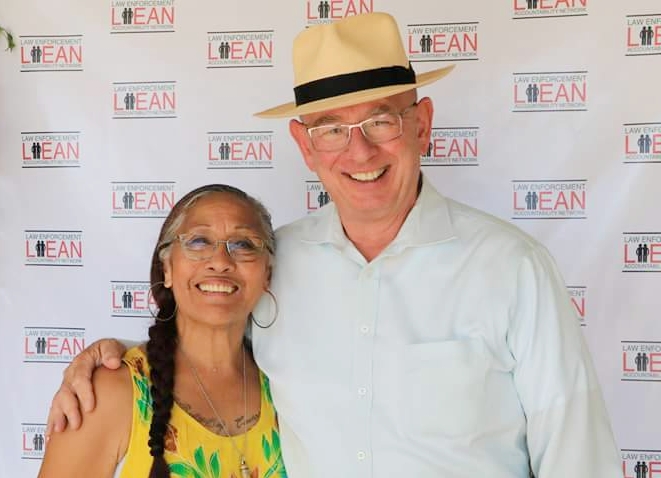
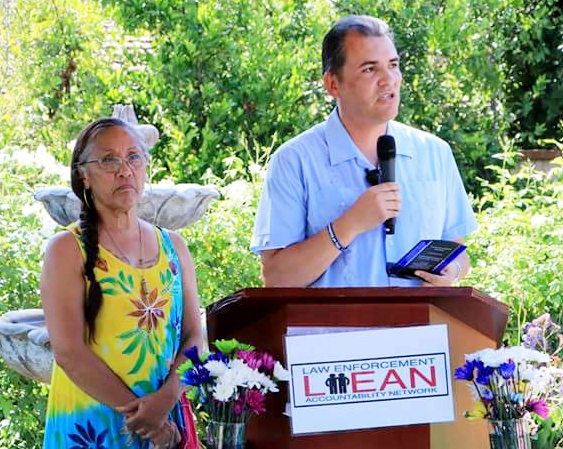
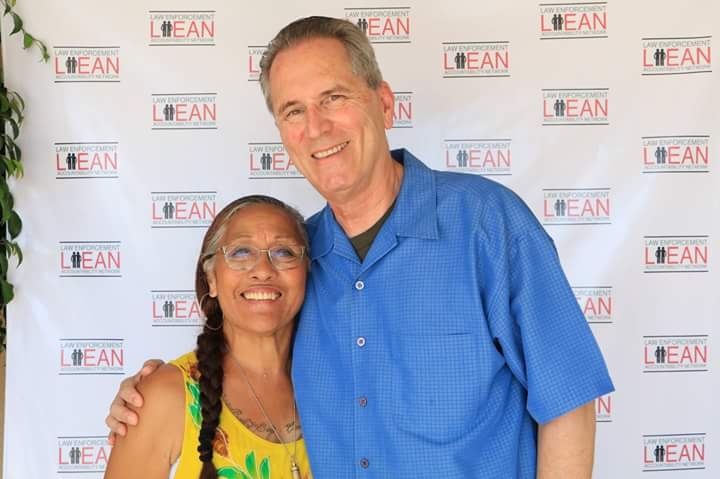
Theresa Smith, the “anti-police activist” founder of LEAN, with Stephen Faessel, an Anaheim City Councilman, who was elected to his seat with $17,389 worth of support from the Anaheim Police Association.
Insider, a regular contributor to that blog, reported about a special event which took place earlier that week where Anaheim City Councilman Jose Moreno, who represents the Third District, received an award from a group characterized as being started by “anti-police activists.”
“This past weekend,” Insider wrote, “Moreno was awarded the Public Service Award by the Law Enforcement Accountability Network, or LEAN“:
LEAN was started by local anti-police activists who frequent Anaheim City Council meetings to criticize the police in the harshest, over-the-top terms. It is ‘fiscally sponsored’ by the ACLU. Despite the group’s soft-pedaled official ‘we want to improve policing’ rhetoric, the people behind it view the police as violent, anti-Latino trigger-happy thugs and are in the bait of denouncing officer-involved shootings as ‘murders.’
In an attempt to prove his point, Insider zeroed in on comments one attendee made on her Facebook page, claiming she “helped organize the protest” in the Palais neighborhood “that predictably degenerated into a riot, leading to ‘protesters’ vandalizing the home of an elderly couple of breaking car windows.”
“This is the spirit of LEAN supporters, and they’ve let us know that Jose F. Moreno is their kind of councilmember,” Insider said.
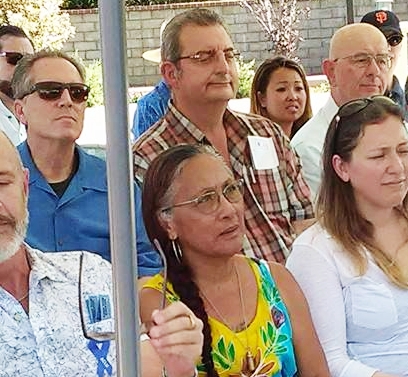
But a two-month investigation by the Anaheim Investigatorhas uncovered dozens of photographs, emails, and other evidence, some of it obtained from the City of Anaheim through California Public Records Act requests, suggesting Insider’s account of this event was not only inaccurate, but misleading. Contrary to Insider’s assertion that “LEAN supporters” were people who “view the police as violent, anti-Latino trigger-happy thugs,” photos show that several prominent Anaheim politicians and businessmen, all of whom have close ties to law enforcement, attended this function.
The Investigatorhas confirmed that Taormina wrote out a $1,000 check to LEAN at their June 25th fundraiser–a huge amount of money, especially since James Gilliam, Deputy Executive Director of the ACLU of Southern California, boasted on Facebook: “We helped [Smith] raise almost $4,000 this afternoon.”
William Taormina (in the plaid shirt) sitting behind Smith.
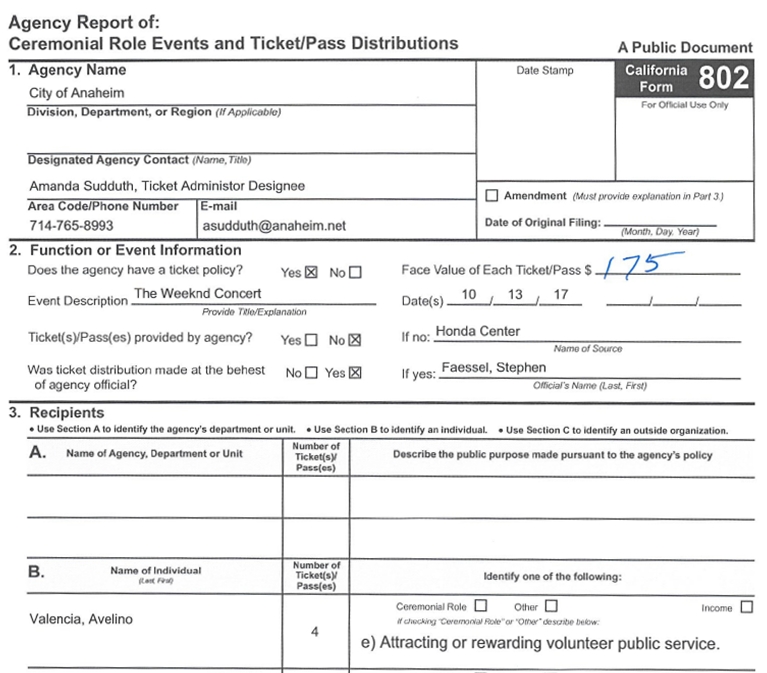
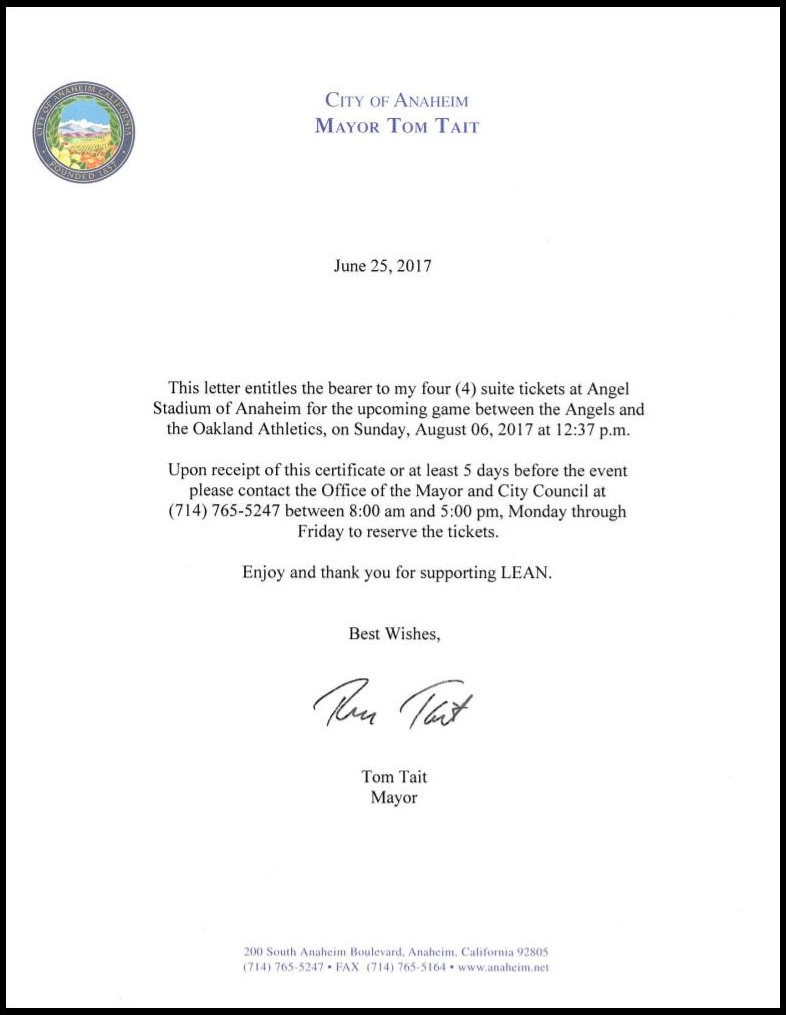
But the biggest donor to LEAN, however, was not Taormina: it was the City of Anaheim. Emails, letters, and documents the Investigator obtained under Public Records Act requests show that Mayor Tait and Councilmen Faessel and Moreno collectively donated sports tickets worth $2,108. According to a California Form 802, “Agency Report of Ceremonial Role Events and Ticket/Pass Distributions,” Tait gave LEAN four “suite” tickets at Angels Stadium for a baseball game between the Los Angeles Angels and the Oakland Athletics. The tickets were valued at $225 each, or $900 total. Another Form 802 shows Moreno also gave LEAN four “suite” tickets at Angels Stadium also worth $900, but for a different game. As for Faessel, his contribution was much smaller, but still significant. A Form 802 reports he donated four “suite” tickets at the Honda Center for a “P&G Gymnastics Championship,” valued at $77 each, or $308 total, a fact later verified via email by Crystal Norman, his former Senior Policy Aide.
The Investigator has learned all of the sports tickets LEAN received from the Mayor and the Councilmen were put up for “silent auction” during the fundraiser. But the winning bidders didn’t receive the actual tickets that day. Instead, they were given a form letter printed on official City of Anaheim stationery, each signed by Tait, Faessal, or Moreno, that entitled the bearer to contact the Office of the Mayor and City Council to make arrangements to pick up the tickets they won. “Enjoy and thank you for supporting LEAN,” all of them said.
A copy of Tait’s letter is below:
All together, the Investigator calculates that Tait, Faessal, Moreno, and Taormina, made donations to LEAN worth a whopping $3,108. Of the estimated 50 people in attendance at the June 25th “Garden Party Fundraiser,” nobody contributed as much to the financial success of this benefit as did these four men.
But all of this begs the following question: Why are members of Anaheim’s political and business elite, all of whom have close ties to law enforcement, showering LEAN with gifts and money?
Will you make a small $5 gift today? Your contribution will allow The Anaheim Investigator to keep delivering hard-hitting investigative journalism that’s open for everyone to see! Nobody covers Anaheim City Hall like like we do. That's why your support is so important to us!














 anaheiminvestigator.com